
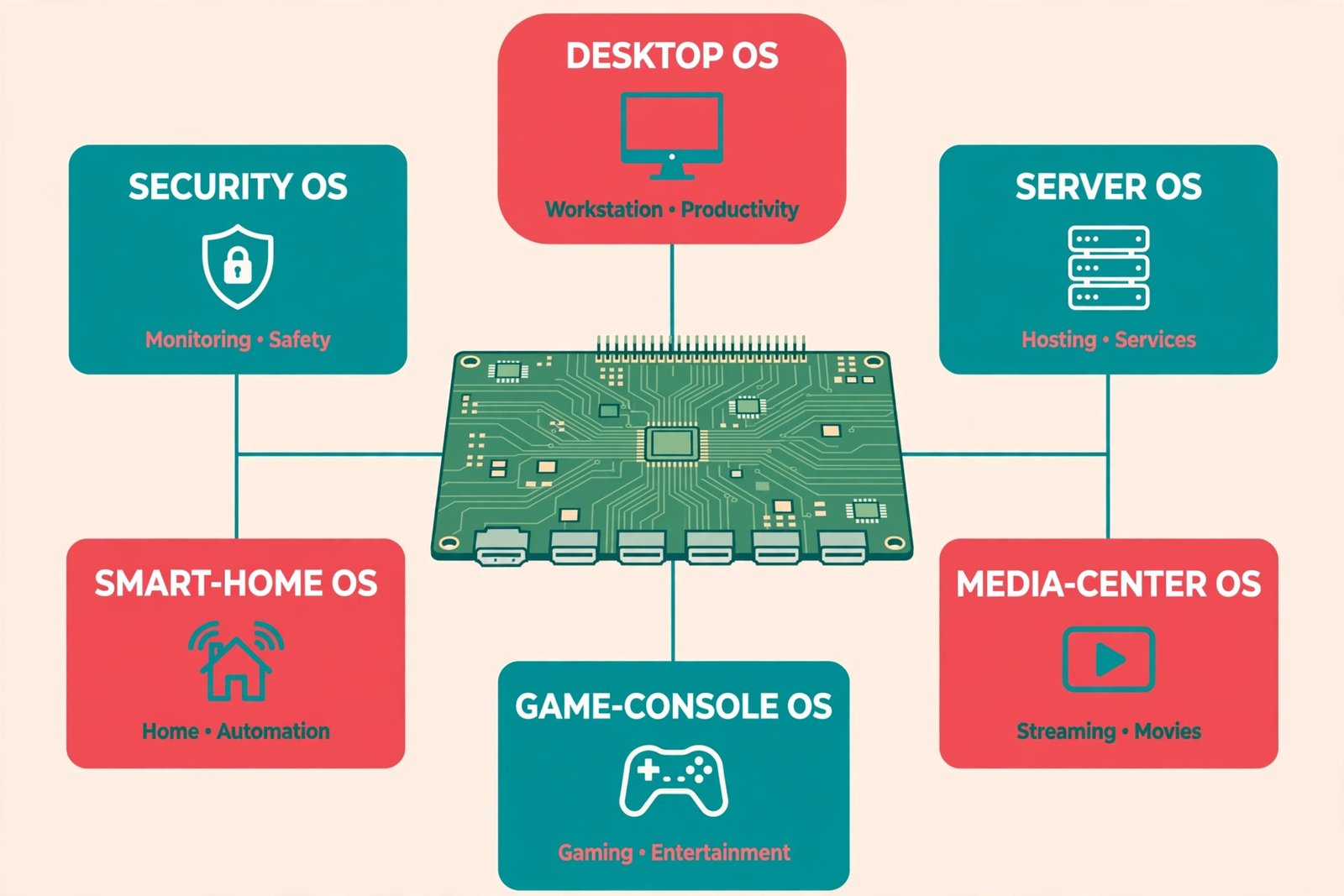
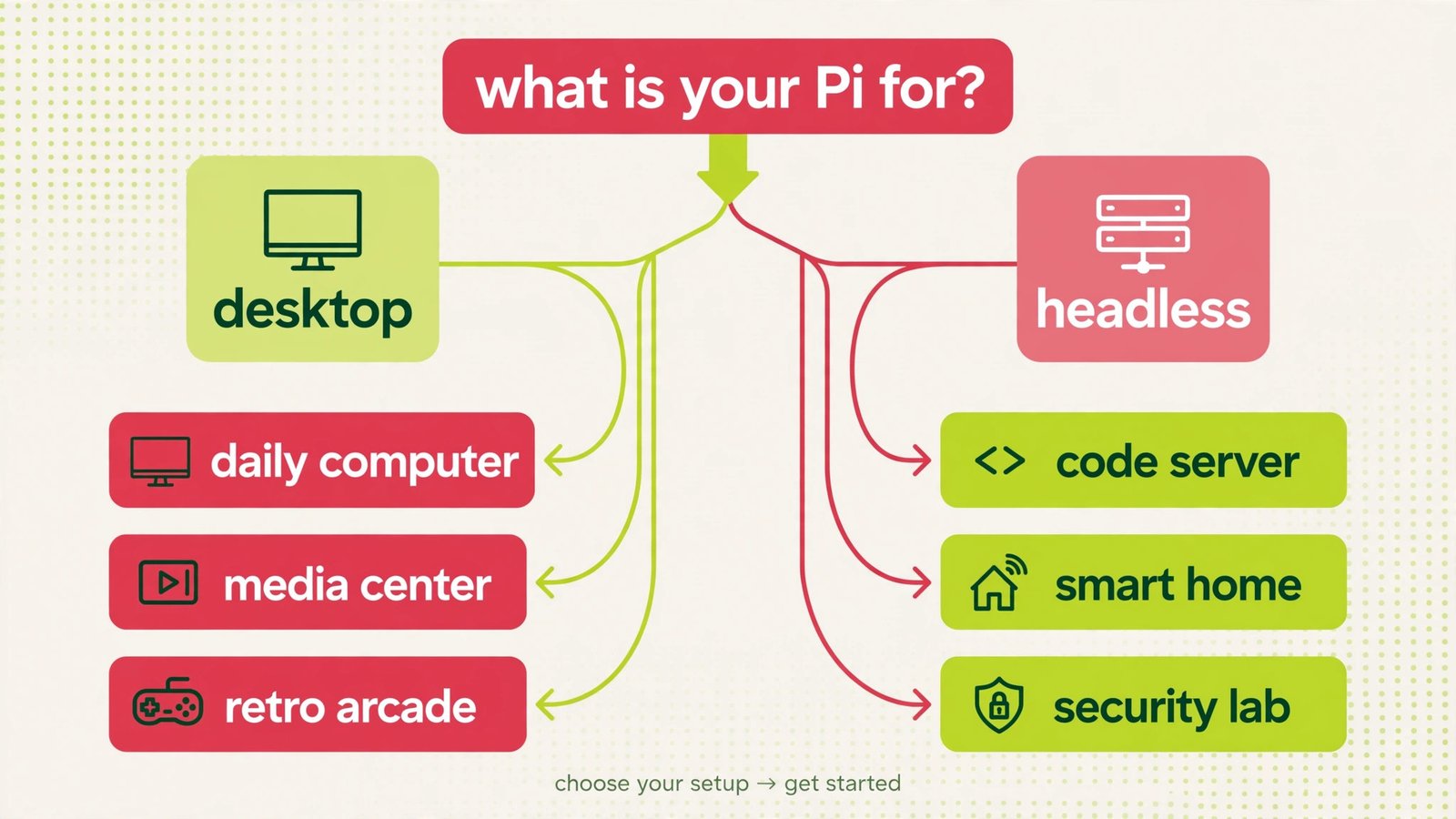
Here is the short version, matched to your board and your job. Pi Zero 2 W as a sensor node or ad blocker? DietPi. Pi 5 as a daily desktop? Raspberry Pi OS, fresh from its October 2026 update. Pi 4 as a TV box? LibreELEC. Pi 5 as a retro console? Batocera, not RetroPie. The full scorecard below explains every one of those calls, including the RetroPie catch that trips up most Pi 5 owners.
The 7 best Raspberry Pi operating systems at a glance
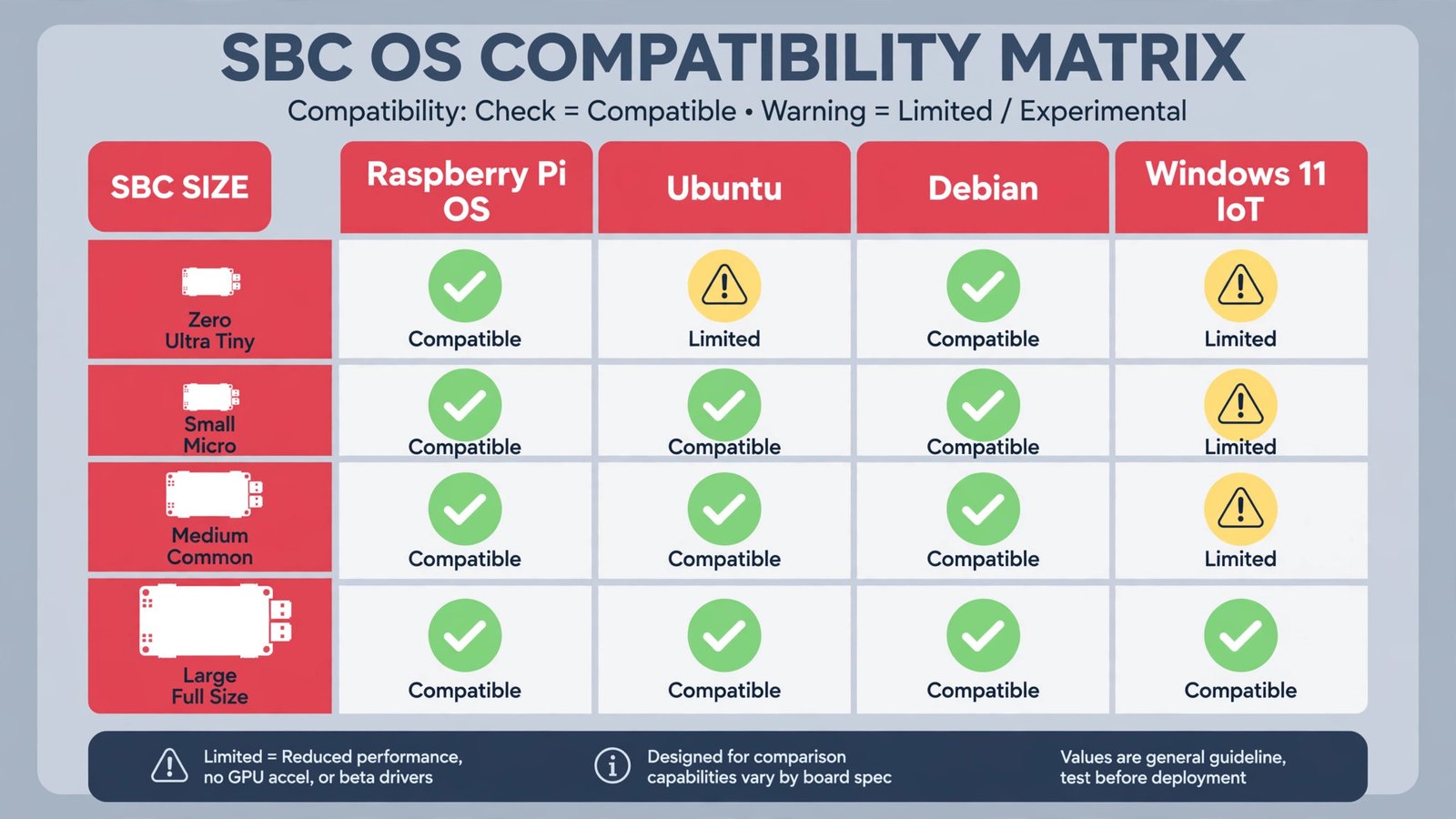
| OS | Best for | Pi models | Desktop | Min RAM |
|---|---|---|---|---|
| Raspberry Pi OS | General use, beginners | All (64-bit: Pi 3B and newer) | Yes | 512MB |
| Ubuntu Server | Servers, containers, dev | Pi 3, 4, 5 | No | 1GB |
| DietPi | Headless, IoT, tiny footprint | All, including Zero | Optional | 256MB |
| LibreELEC | Media center (Kodi) | Pi 3, 4, 5 | Kodi UI | 1GB |
| Batocera | Retro gaming on Pi 5 | Pi 3, 4, 5 | Game UI | 1GB |
| RetroPie | Retro gaming for tinkerers | Pi 3, 4 (Pi 5: manual install) | Game UI | 1GB |
| Home Assistant OS | Smart home hub | Pi 3, 4, 5 | Web UI | 2GB |
1. Raspberry Pi OS: the best for most Pi owners
The official OS just got its October 2026 refresh: new images released October 6 rebased on Debian 13 “Trixie” with the Linux 6.18 kernel, running the labwc Wayland compositor on the desktop. It comes in three editions (Desktop, Full, and Lite for headless setups), and the Lite image is a perfectly good server base too. If you are unsure which OS to pick, this is the one.
- Specifications: Debian 13 base, Linux 6.18; Desktop, Full, and Lite editions; 32-bit legacy edition still available for the oldest boards; flashes with Raspberry Pi Imager.
- Reasons to use: Best hardware support of any option, GPIO and camera integration just work, and the documentation assumes you are running it.
- Reasons to avoid: The desktop is functional rather than beautiful; power users will outgrow it and move to Ubuntu or DietPi.
Scorecard: Ease 5/5, the friendliest start in the Pi world. Hardware fit 5/5, built for this board. Performance 4/5, solid, not record-breaking.
2. Ubuntu Server: the best for servers and developers
When your Pi is a tiny server, Ubuntu Server gives you the biggest software library, the best documentation, and proper container tooling. It is the natural home for Docker stacks, self-hosted apps, and development work that mirrors an Ubuntu production box. Needs a Pi 3 or newer and at least 1GB of RAM to breathe.
- Specifications: Ubuntu 24.04 LTS base (26.04 LTS also available); headless by default; snap and Docker support; cloud-init for repeatable setups.
- Reasons to use: Unmatched package availability and community knowledge; pairs perfectly with beginner-friendly Linux guides when you are learning server basics.
- Reasons to avoid: Heavier than DietPi or Pi OS Lite; overkill for a single-purpose Pi Zero project.
Scorecard: Ease 4/5, familiar if you know Ubuntu. Hardware fit 4/5, great on Pi 4 and 5. Performance 4/5, heavier but capable.
3. DietPi: the best for tiny boards and headless jobs
DietPi is the featherweight champion: it idles at around 42MB of RAM and takes about 531MB of disk, which makes it the obvious choice for a Pi Zero 2 W running Pi-hole, a sensor node, or a headless automation box. A setup wizard handles Wi-Fi, software installs, and updates in minutes.
- Specifications: Debian-based; optional lightweight desktops; one-command software installer for 200+ packages; runs on every Pi model.
- Reasons to use: Squeezes maximum life out of old and small boards; the software installer saves hours; rock-stable for always-on jobs.
- Reasons to avoid: Minimal hand-holding beyond the installer; not the pick if you want a full desktop experience.
Scorecard: Ease 3/5, assumes some comfort with the terminal. Hardware fit 5/5, runs on literally everything. Performance 5/5, nothing lighter exists.
4. LibreELEC: the best media center
LibreELEC does one thing: it turns your Pi into a Kodi box. The entire OS is just enough Linux to run Kodi, which means fast boots, smooth 1080p and 4K playback on the Pi 4 and 5, and a remote-friendly interface your whole household can use.
- Specifications: Just-enough-OS design; Kodi frontend; Pi 3, 4, and 5 supported; tiny footprint.
- Reasons to use: The simplest path to a living-room media PC; boots straight into Kodi; very low maintenance.
- Reasons to avoid: It is a media appliance, not a general computer; forget running a desktop or server apps on it.
Scorecard: Ease 5/5, appliance-simple. Hardware fit 4/5, great on Pi 4 and 5. Performance 5/5, purpose-built for playback.
5. Batocera: the best retro gaming on the Pi 5
Here is the 2026 reality check on Pi retro gaming: Batocera ships an official Raspberry Pi 5 image, so you flash it and boot straight into a polished EmulationStation frontend with 70+ pre-configured emulators and Kodi built in. It is the easy path, and on the Pi 5 it is the only path with a one-click image.
- Specifications: Standalone gaming distro; official Pi 5 image with hardware video acceleration; EmulationStation frontend; controller-friendly from first boot.
- Reasons to use: Fastest route to a working retro console on a Pi 5; slick UI; huge emulator library out of the box.
- Reasons to avoid: Less customizable under the hood than RetroPie; the community is smaller.
Scorecard: Ease 5/5, flash and play. Hardware fit 5/5, the Pi 5 pick. Performance 4/5, defaults favor speed over accuracy.
6. RetroPie: the best retro gaming for tinkerers (with a catch)
RetroPie remains the most customizable retro-gaming setup with the largest community, but be honest with yourself about the catch: the project’s last packaged release is v4.8, and there is no official Pi 5 image. On a Pi 5 you install plain Raspberry Pi OS first and build RetroPie on top via the setup script. On a Pi 4 or older, the classic images still work exactly as they always have.
- Specifications: EmulationStation + RetroArch; ~50 emulators; Pi 5 support via manual setup-script install only.
- Reasons to use: Deepest customization, biggest community, most guides and themes.
- Reasons to avoid: No Pi 5 image as of late 2026; the manual route takes an evening and some terminal comfort.
Scorecard: Ease 2/5 on a Pi 5, 4/5 on older boards. Hardware fit 3/5, the Pi 5 situation drags it down. Performance 4/5, excellent once running.
7. Home Assistant OS: the best smart home hub
If the Pi’s job is running your house, Home Assistant OS is purpose-built for it: the whole system is the Home Assistant platform with a web UI, add-ons for everything from Zigbee to energy monitoring, and automatic updates. A Pi 4 or 5 with 2GB+ RAM makes a superb always-on hub.
- Specifications: Dedicated smart-home OS; web-based management; add-on store; Pi 3, 4, and 5 supported.
- Reasons to use: The gold standard for local, private smart-home control; huge device support; pairs well with a broader home-security setup.
- Reasons to avoid: Single-purpose by design; needs 2GB RAM minimum for a smooth experience.
Scorecard: Ease 4/5, web UI does the heavy lifting. Hardware fit 4/5, happiest on a Pi 4 or 5. Performance 4/5, reliable always-on.
Honorable mentions
Kali Linux is the pick for penetration testing and security coursework on a Pi, with hundreds of tools pre-installed. Twister OS wraps Raspberry Pi OS in Windows- and macOS-style themes with gaming tools for tinkerers who want a familiar face. Ubuntu Desktop 24.04 gives you a polished GNOME desktop on a Pi 5 with 4GB or more, if you want the Pi to feel like a real PC.
Our verdict: match the OS to the job
New to the Pi? Raspberry Pi OS, always. Running services? Ubuntu Server on a Pi 4/5, DietPi on anything smaller. Living-room TV? LibreELEC. Retro games on a Pi 5? Batocera for easy, RetroPie if you enjoy the build. Smart home? Home Assistant OS. Flash it all with the official Raspberry Pi Imager, and if you are reviving non-Pi hardware too, see our lightweight OS picks for old laptops.

- 11 Cable Management Tricks for a Clean Desk (2026) - October 10, 2026
- Best Gmail Alternatives in 2026: Proton Mail vs Tuta (Duel) - October 10, 2026
- The 7 Best Linux Distros for Raspberry Pi in 2026 (Matched to Your Pi) - October 10, 2026