
Canva’s free plan caps AI uses at 50 a month, and Pro now costs $119.99 a year. If you design for print, the free plan’s export limits bite fast. And if you already pay for Adobe Creative Cloud or Microsoft 365, Canva’s subscription is money spent twice. The winner of this roundup is Adobe Express, the closest like-for-like Canva replacement with commercially safe AI. Microsoft Designer is the best free pick, Kittl wins for print-on-demand sellers, and Figma is the right call for product and UI teams. This guide scores all four against Canva on templates, AI features, ease of use, and value, with 2026 pricing verified on each vendor’s own pages.
Canva Alternatives at a Glance
Before the deep dive, the quick comparison. Prices below are current list prices checked in 2026; they move, so confirm on the vendor’s pricing page before you pay.
| Tool | Free tier | Paid plan | Standout strength | Best for |
|---|---|---|---|---|
| Adobe Express | Yes, no card required | $9.99/mo or $99.99/yr | Firefly AI, 200M+ stock assets | Closest Canva replacement |
| Microsoft Designer | Yes, with Microsoft account | Free; more creation with Microsoft 365 | Fast AI social posts | Budget creators in the Microsoft ecosystem |
| Kittl | Yes, limited (attribution required) | Pro $10/mo billed yearly; Expert from $24/mo | Typography and print-on-demand | T-shirt and merch sellers |
| Figma | Yes (3 files) | $16/full seat/mo billed yearly | UI design systems, prototyping | Product and web design teams |
The Best All-Round Canva Replacement: Adobe Express
Adobe Express is the only tool here that tries to be Canva, rather than something adjacent to it. Template-first editor, social posts, flyers, short videos, brand kits, and a content scheduler, all in the browser. Its edge is Adobe Firefly: AI image generation trained on commercially safe data, which matters the moment a client asks who owns the output. The free plan is genuinely usable (100,000+ templates, no payment card), and Premium at $9.99 a month undercuts Canva Pro while adding 250 generative credits monthly and 100GB of storage.
- Reasons to try it: closest workflow match to Canva; Firefly AI is safe for client work; syncs with Photoshop and Illustrator files if you use them.
- Reasons to skip it: the template library is far smaller than Canva’s millions; the web app can feel sluggish on older hardware; some AI features sit behind Premium.
The Best Free Pick: Microsoft Designer
Microsoft Designer is the answer to “I just need quick social posts and I do not want another subscription.” It is free with any Microsoft account, generates images and layouts from a text prompt, and slots naturally next to Copilot and Microsoft 365. For invitations, cards, social graphics, and fast AI edits, it covers the 80 percent of Canva most casual users actually touch.
- Reasons to try it: completely free to start; fastest path from idea to finished social post; no new account if you already use Microsoft services.
- Reasons to skip it: a narrower feature set than Canva or Express, with no real brand-kit or team controls; heavier AI creation may require a Microsoft 365 subscription; design depth stops where professional work begins.
The Best for Print-on-Demand: Kittl
Kittl does not want to be Canva; it wants to be the tool behind your merch store. Its typography engine, vintage text effects, and mockup workflow are built for t-shirts, posters, and stickers, and its AI credits generate print-ready artwork rather than social posts. Pro costs $10 a month billed yearly ($120/year), and the Expert tier from $24 a month adds serious AI capacity for high-volume sellers. If you pair designs with generated imagery, these AI art generator apps can feed Kittl’s print workflow.
- Reasons to try it: best-in-class text effects and print mockups; commercial license with no attribution on paid plans; cheaper than Canva Pro for sellers.
- Reasons to skip it: the free plan is very limited (low-res downloads, attribution required); weak for presentations and social scheduling; not a general-purpose design tool.
The Best for Product and UI Teams: Figma
Figma is the odd one out: a professional UI design platform, not a template app. It belongs here because “Canva alternative” searches from freelancers and startups often really mean “I need to design app screens and websites.” For that, nothing touches Figma’s component libraries, auto-layout, prototyping, and developer handoff. The Starter plan is free (3 design files), and Professional is $16 per full editor seat per month on annual billing, with cheaper Dev and Collab seats for engineers and stakeholders. Students and educators get it free.
- Reasons to try it: the industry standard for UI and web design; real-time multiplayer editing; free tier is enough to learn on.
- Reasons to skip it: massive overkill for flyers and Instagram posts; per-seat pricing gets expensive for teams; a real learning curve versus Canva’s drag-and-drop.
The Scorecard
Scores are out of 5, judged for a typical solo creator or small team comparing against Canva. No tool gets straight 5s; the gaps are the point.
| Criteria | Adobe Express | Microsoft Designer | Kittl | Figma |
|---|---|---|---|---|
| Ease of use | 4.5 (Canva-like, gentle learning curve) | 5 (simplest tool here) | 4 (easy, but print-focused UI) | 3 (pro tool, real learning curve) |
| Templates | 4 (100K+, far fewer than Canva) | 3.5 (solid for social, thin elsewhere) | 4.5 (excellent for merch, narrow otherwise) | 3 (community files, not templates) |
| AI features | 4.5 (Firefly, commercially safe) | 4 (fast generation, metered) | 4 (strong for print artwork) | 4 (design-focused AI, credit metered) |
| Value | 4.5 ($9.99/mo undercuts Canva Pro) | 5 (free) | 4 ($120/yr Pro is fair for sellers) | 3 (great free tier; seats add up) |
| Ecosystem | 5 (Adobe fonts, stock, CC sync) | 4 (Microsoft 365, Copilot) | 3 (print platforms, little else) | 5 (plugins, dev handoff, community) |
Which One Should You Pick?
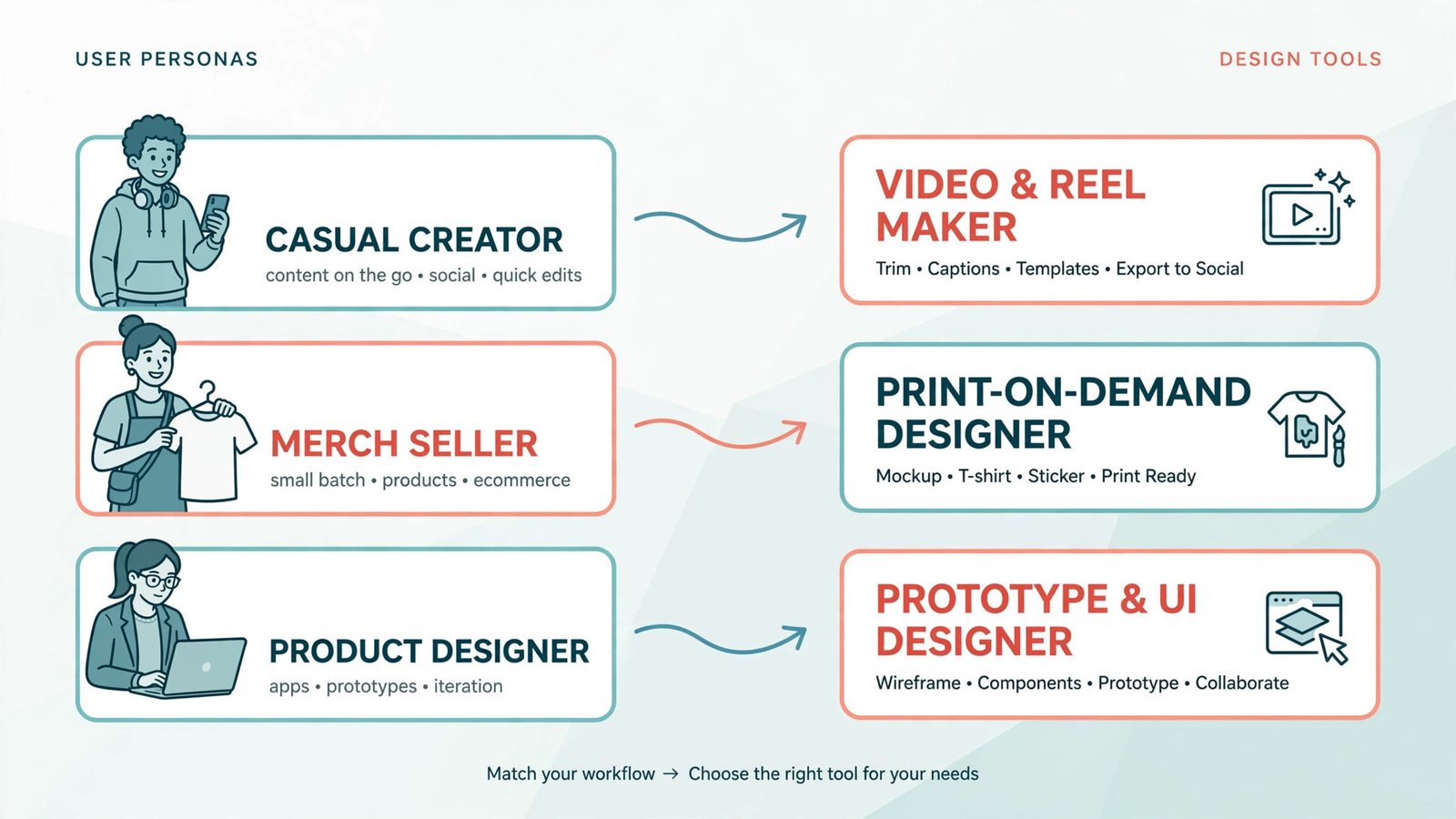
Match the tool to the work. If you want Canva but cheaper or inside Adobe’s world, take Adobe Express. If you design occasionally and hate subscriptions, Microsoft Designer costs nothing to try. If you sell merch, Kittl pays for itself in a week. If you design interfaces, stop comparing template apps and learn Figma. Also consider Photopea, a free browser-based Photoshop clone, if your real need is photo editing rather than templates; and if background removal is the specific job, these background remover tools do it better than any all-rounder.
Quick Answers
Is there a completely free alternative to Canva? Yes. Microsoft Designer is free with a Microsoft account and covers social posts, cards, and AI image generation. Adobe Express and Kittl also have free tiers, but with meaningful limits on exports and AI use.
Which Canva alternative is best for print-on-demand? Kittl, by a clear margin. Its typography tools, text effects, and mockup workflow are built for merch, and the paid plans include a commercial license with no attribution requirement.
Can I move my Canva designs into these tools? Not directly. None of them import Canva’s proprietary project files. Export finished work as PNG, SVG, or PDF from Canva, then rebuild editable versions in the new tool. For photo-heavy projects, the photo editor apps roundup covers stylized editing Canva does poorly.

- How to Rebuild the Spotlight Index on Mac - October 25, 2026
- How to Change the Screenshot Save Location on Mac - October 24, 2026
- How to Turn Off Stage Manager on Mac - October 23, 2026