
If your evenings end in a battle over bedtime, the story is usually not the problem. The way the story is told is. Here is how to make storytelling the thing that actually helps your child fall asleep, at every age.
Why a Story Works Better Than Almost Anything Else
A bedtime story does several jobs at once. Your voice slows down, so your child’s breathing follows. The plot gives a busy mind somewhere gentle to land. And the ritual itself becomes a cue: when this story starts, the day is over and it is safe to rest.
That is why stories beat screens and even music. A recording cannot notice your child is getting drowsy and soften its voice. You can. The story bends around your child; nothing else does that.
Set the Stage Before You Open the Book
The story works best when it lands at the end of a calm, predictable wind-down. You do not need a rigid timetable, just the same sequence most nights, starting about 30 to 45 minutes before lights-out:
- Dim the lights in the house. Overhead brightness tells the brain it is daytime.
- Screens off, including the TV in the background. Even a tablet in the corner pulls attention.
- Bath, teeth, pajamas, in that order. The predictability is the point.
- One short “connection minute” first: ask what the best and hardest parts of the day were. Many kids stall at bedtime because they are not ready to be apart from you yet. Two minutes of real attention now saves twenty minutes of stalling later.
- Then the story, then sleep. Let your child choose the story. A child who picked the book argues less about it ending.
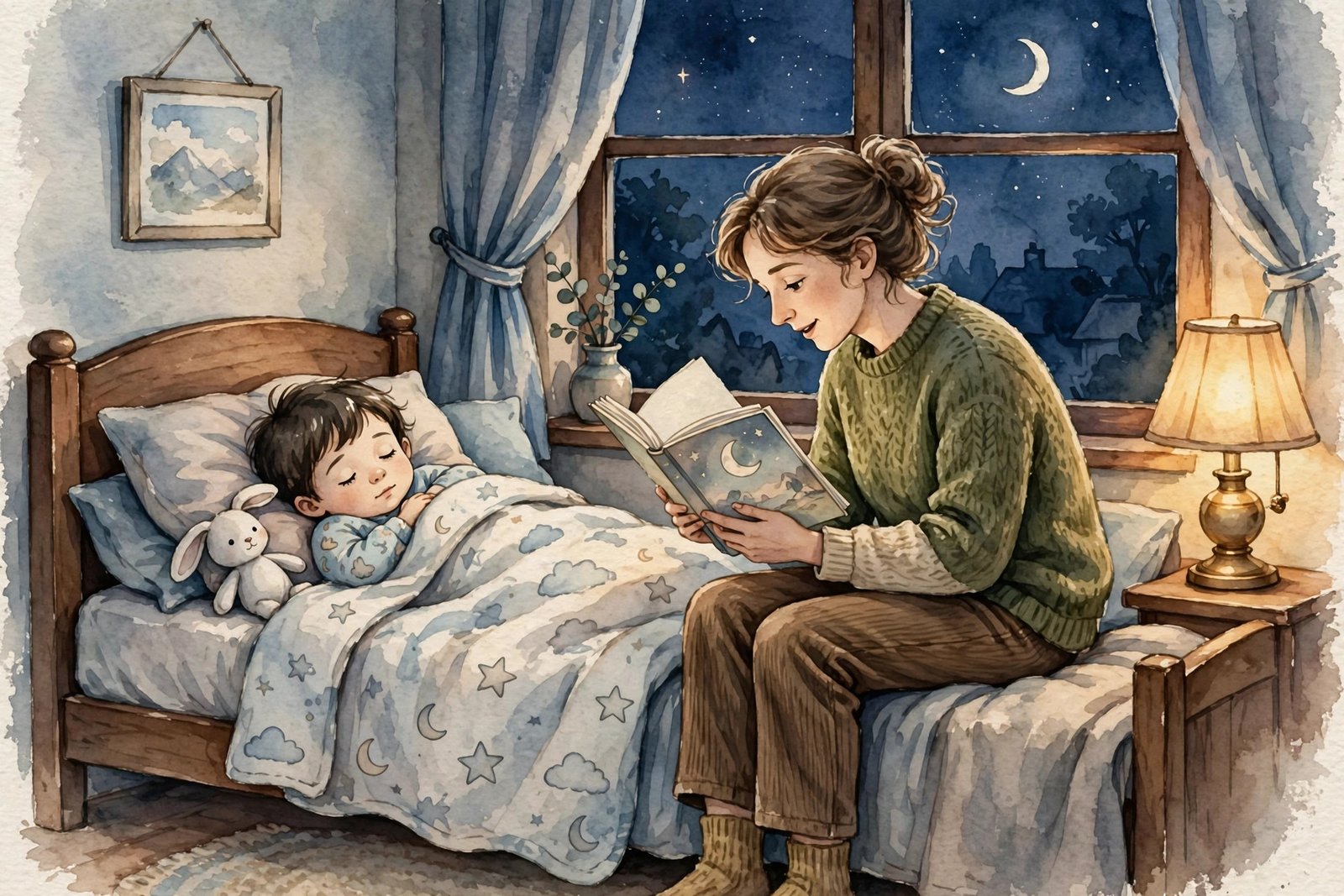
Five Techniques That Help Kids Drift Off
You do not need acting skills. You need pacing, softness, and restraint.
1. Get quieter as you go
Start at a normal storytelling voice and let it drop a notch every few minutes. By the last page, you should be close to a whisper. Your child’s body matches your volume, and sleepiness follows.
2. Slow the rhythm down
Read at about half your normal speaking pace. Add long pauses between sentences, especially near the end. If you catch yourself speeding up because you want to finish, that is the cue to slow down more. Rushing raises energy; lingering lowers it.
3. Use repetition and rhythm
Rhymes, refrains, and repeated phrases are sedatives in disguise. When the brain can predict what comes next, it stops working hard and starts letting go. This is why children ask for the same story every night. Let them. The repetition is doing the heavy lifting.
4. End on something calm and closed
Skip stories with big twists, chases, or cliffhangers at bedtime. The last two minutes should move toward rest: the character is safe, the world is quiet, everyone is going to sleep. A simple rule: if the ending makes your child want to know what happens next, it was the wrong story for bedtime.
5. Let the story fade on purpose
If your child is nearly asleep mid-story, do not finish it. Trail off at a peaceful moment: “…and the stars came out one by one, and she closed her eyes, and…” Let them imagine the rest. Finishing loudly wakes them back up. Some parents even stop the story on purpose at the sleepy part and save the ending for tomorrow.
What to Tell at Each Age
Ages 0 to 2: Keep it to five minutes or less. Rhyming board books, nursery rhymes, and naming things in the pictures. At this age your voice and your closeness are the story. Point at pictures, name them, keep the tone singsong.
Ages 3 to 5: Simple plots with familiar animals, gentle problems that get solved, and happy, quiet endings. Repetitive phrases are magic at this age (“and the little bear said goodnight to the trees…”). This is also the peak age for the same story every night. Do not fight it.
Ages 6 to 8: Longer stories, real characters, small adventures. You can read one chapter of a calm chapter book and stop at a quiet moment. This is also a great age for making up stories together, with your child naming the hero, the place, or the animal. If evenings with your family tend toward games instead, board games for kids can be another screen-free ritual before the wind-down begins.
Ages 9 and up: Many kids this age start reading alone in bed, and that is fine. If they still want to be read to, read what they are reading: a novel, a nonfiction book about something they love, even poetry. The bonding matters more than the content now. Older kids who have moved past storytime entirely may prefer time together a different way, like the board games for teenagers they will actually agree to play.

Two Original Bedtime Stories to Start Tonight
Here are two short stories written for this guide. One is for toddlers and preschoolers, the other for ages four to eight. Read them slowly, get quieter as you go, and let the endings fade.
The Sleepy Lantern (ages 2 to 5)
Every evening, when the sky turned purple, Milo the firefly lit his little lantern and flew down the garden path. He always stopped at the same three friends to say goodnight.
First the daisies. “Goodnight, daisies,” Milo whispered, and the daisies folded their petals, one by one, like tiny hands closing.
Then the pond. “Goodnight, frogs,” Milo whispered, and the frogs stopped their singing and tucked their heads under the lily pads.
Last the old oak tree. “Goodnight, owl,” Milo whispered. The owl opened one sleepy eye, then closed it again.
Milo flew home, turned his lantern down low, and crawled into his leaf bed. “Goodnight, Milo,” said the night. And Milo said, “Goodnight.” Then he closed his eyes, just like the daisies. Just like the frogs. Just like the owl. Just like you.
The Night the Moon Painted Slowly (ages 4 to 8)
Nina noticed that the moon was late that night. When it finally rose over the rooftops, it looked pale and tired. So Nina, who was very good at helping, climbed to her window and asked, “Moon, what is wrong?”
“I have to paint the whole night sky,” the moon sighed, “and I am so tired that my paintbrush feels heavy.”
“Then paint slowly,” Nina said. “I will help by watching.”
So the moon dipped its brush and painted the first star. Then it rested. Then the second star. Then it rested longer. Nina yawned. The moon painted the third star, and its arm was so heavy it could barely lift the brush.
Star by star, the night grew silver and soft. The moon’s brushstrokes got slower, and slower, and slower, until the last star was painted with a brushstroke so gentle it was almost a whisper. The moon hung its brush up, settled into the clouds like a pillow, and fell asleep. Nina was already asleep too. And the painted stars stayed up all night, keeping watch, very, very quietly.
Mistakes That Undo the Good the Story Does
- One more chapter, then one more. Decide the number before you start. “Two chapters” means two, even when they beg beautifully.
- Stories with energy. Adventure, jokes, and surprise endings belong to daytime. At night, excitement is the enemy.
- A phone in your hand. Checking your phone mid-story tells your child the story is not important enough for your full attention. They will match that energy and start stalling.
- Starting too late. If your child is already overtired and wired, no story can undo it. Move the routine earlier, not the story shorter.
- Inconsistent timing. Bedtime that swings an hour night to night fights the body’s clock. Aim for the same window every evening, weekends included.

Our Take
The book matters less than the ritual. Pick short, gentle stories with quiet endings, tell them at the same time every night, and let your voice wind down as the story goes on. Do that for two weeks and most bedtime battles get noticeably smaller. The story is not a performance; it is a signal that says the day is done and you are here. That signal is the whole point.

- How to Fix Windows 11 Search Not Finding Files - October 24, 2026
- How to Fix Windows 11 Clock Showing the Wrong Time - October 23, 2026
- How to Fix File Explorer Slow to Open in Windows 11 - October 22, 2026