
Picking a handheld gaming PC in 2026 has less to do with specs than it used to. Every serious device on this list runs the same Steam library, and the differences that matter are the ones you feel every day: whether the device wakes from sleep instantly, whether your games live in Steam or across five launchers, and how much you are willing to pay for a nicer screen. Here is a shortlist of five devices that are actually current, with prices verified on October 16, 2026, and an honest look at the ones that did not make it.
The deciding factor: SteamOS or Windows
Before comparing hardware, decide which camp you belong to. SteamOS, which powers the Steam Deck and the Lenovo Legion Go S (SteamOS), behaves like a console. You press the power button and your game resumes exactly where you left it, updates happen quietly in the background, and everything is built for a controller. Windows handhelds behave like a laptop. You get the full desktop, which means native Xbox Game Pass, the Epic Games Store, GOG, Battle.net, and every mod and utility that assumes Windows. The tradeoff is Windows itself: standby battery drain, update prompts at bad times, and menus that clearly were not designed for a 7-inch screen.
There are also hard compatibility lines. Many competitive multiplayer games with kernel-level anti-cheat, like some Call of Duty and Valorant-style titles, do not run on SteamOS. If those are your main games, Windows is not optional. If your library is mostly single-player and indie games from Steam, SteamOS is the calmer daily experience. Our guide to free alternatives to Windows digs deeper into the Linux side of this tradeoff if you want more background.
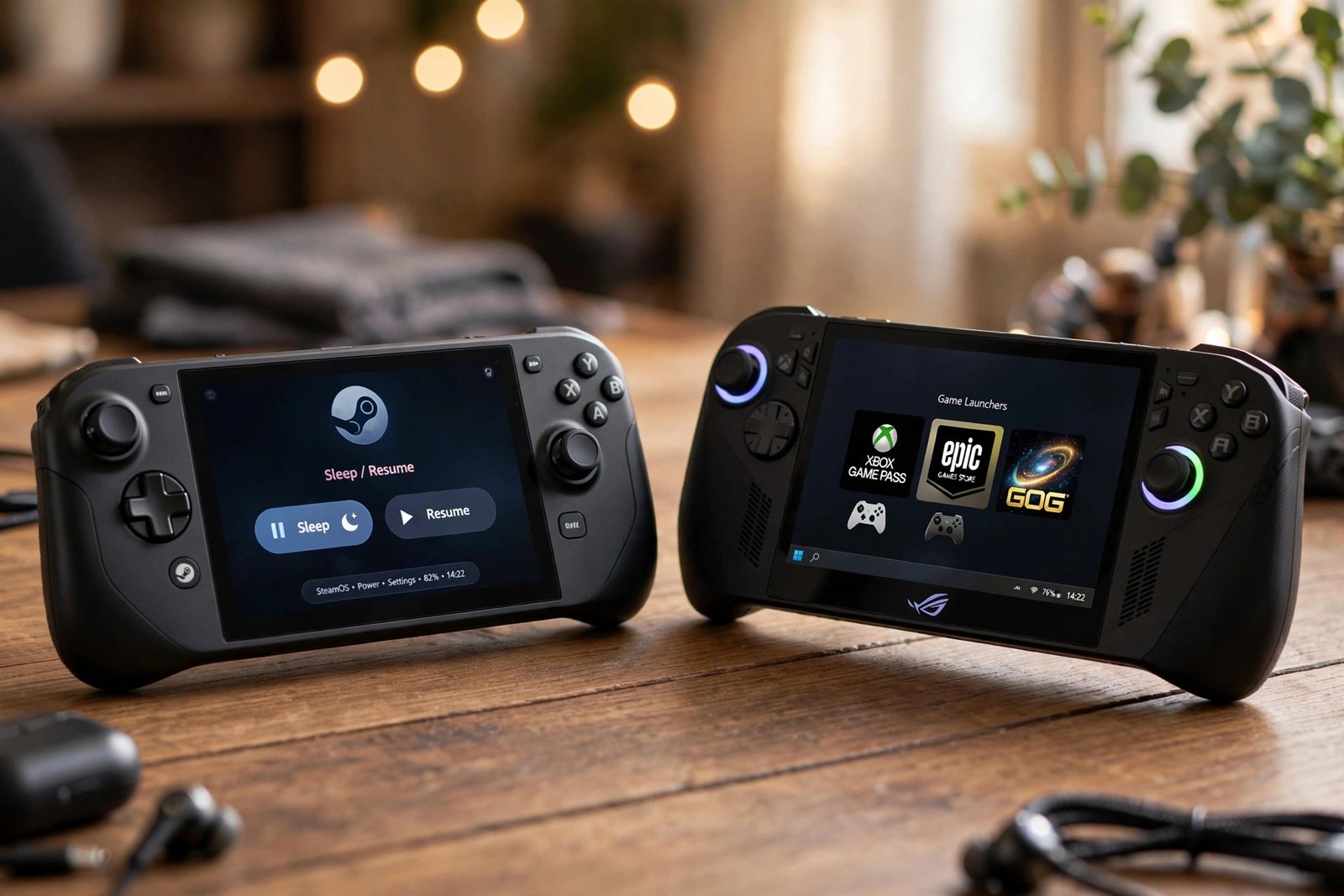
The shortlist: five handhelds worth buying in 2026
Four manufacturers, two operating systems, and prices that moved sharply this year because memory and storage costs surged. Every price below was checked on October 16, 2026, either on the official store page or against current official listings.
Steam Deck OLED: still the simplest pick
The Steam Deck remains the benchmark everything else is measured against, and Valve kept its crown by doing less. The 7.4-inch HDR OLED display at 1280 by 800 and 90Hz still looks gorgeous, the custom AMD APU with 16GB of RAM handles the vast majority of the Steam catalog through Proton, and suspend and resume works so reliably you will take it for granted within a week. The one shock is the price. Valve raised prices on May 27, 2026, citing memory and storage costs: the 512GB model now costs $789 and the 1TB model costs $949 on the Steam store page (price checked 2026-10-16 against Valve’s May 2026 revision). Refurbished units start at $629 for buyers who want the Deck experience for less.
ROG Xbox Ally X20: the best Windows handheld experience
ASUS launched this device on October 15, 2026, the day before this article, so it is literally the newest option here. The X20 is the successor to the 2025 ROG Xbox Ally X, and it fixes the biggest complaint about that device: the screen is now a 7.4-inch ROG Nebula HDR OLED at 1080p and 120Hz with FreeSync Premium Pro, up from IPS. The internals stay strong with a Ryzen AI Z2 Extreme chip, 24GB of LPDDR5X memory, a 1TB SSD, and an 80Wh battery. It runs Windows 11 under the Xbox full-screen experience, a controller-first shell that aggregates Steam, Battle.net, and Game Pass into one library view while keeping the full Windows desktop available underneath. Standalone pricing is $1,299.99 according to ASUS’s official launch announcement (price checked 2026-10-16). There is also a $2,499.99 anniversary bundle with AR glasses and a Pelican case, but most buyers will want the standalone unit.
Lenovo Legion Go S (SteamOS): the bigger Steam Deck
If you like the Steam Deck but want a larger screen and stronger hardware, this is the closest thing to a bigger Deck that officially runs Valve’s operating system. The Legion Go S pairs an 8-inch 1920 by 1200 IPS display at 120Hz with VRR against either a Ryzen Z2 Go chip or, in the higher-tier configuration, a Ryzen Z1 Extreme with 32GB of RAM and 1TB of storage. SteamOS on non-Valve hardware works the way it does on the Deck, including the excellent suspend and resume. Two cautions. First, the 55.5Wh battery is the smallest here, so expect roughly two to two and a half hours of heavy gaming. Second, pricing is messy: Lenovo raised the base SteamOS model’s list price to $1,049.99 on lenovo.com (price checked 2026-10-16), while Best Buy has listed the more powerful Z1 Extreme 32GB and 1TB configuration at $899.99. Shop around before you buy. A Windows version of the Go S also exists for buyers who want this hardware with Game Pass.
MSI Claw 8 AI+: the Intel alternative with the big battery
MSI is the only major brand betting on Intel for handhelds. The Claw 8 AI+ runs a Core Ultra 7 258V Lunar Lake chip with Intel Arc 140V graphics, 32GB of fast LPDDR5x memory, a 1TB SSD, and an 8-inch 1920 by 1200 IPS display at 120Hz with VRR. It has the largest battery class in the shortlist at 80Wh, two Thunderbolt 4 ports for easy docking, Hall effect sticks that resist drift, and it runs full Windows 11. The list price is $899.99, though retail prices drifted toward roughly $1,149 during the summer of 2026 as component costs rose (price checked 2026-10-16 against MSI’s MSRP and current retail tracking). Note that MSI also sells a pricier Claw 8 EX AI+ with Intel’s newer Arc G3 silicon at $1,499 to $1,799; that is a halo product, and the standard AI+ remains the sensible Claw to buy.
Lenovo Legion Go 2: the premium screen, at a volatile price
The Legion Go 2 is the most complete handheld on paper: an 8.8-inch OLED display at 1920 by 1200 and 144Hz with VRR, a Ryzen Z2 Extreme chip, 32GB of LPDDR5X memory, a 74Wh battery, and detachable TrueStrike controllers with Hall effect sticks and an FPS mode that turns one controller into a mouse. It is also the hardest to recommend at official pricing right now. The base configuration launched from $1,349 in late 2025, but Lenovo’s official listings have swung wildly in 2026; in mid-October 2026 the top configuration was listed at over $3,000 and marked as unavailable for purchase, and earlier listings sat at $1,999 and $2,849. If you find one at a sane street price, it is the best screen you can get on a handheld PC. At list price, this much money buys a genuinely capable gaming laptop, and our roundup of prebuilt gaming PCs is worth a look before you spend it.

Spec comparison: price, display, performance, battery
All five devices are real handheld PCs that run your Steam library. They separate on display quality, battery size, weight, and of course price. Prices were checked October 16, 2026.
| Device | Price (USD, checked 2026-10-16) | Display | Chip and RAM | Battery | Weight | OS |
|---|---|---|---|---|---|---|
| Steam Deck OLED | $789 (512GB) / $949 (1TB) | 7.4 in OLED, 1280 x 800, 90Hz | Custom AMD APU, 16GB | 50Wh | 640g | SteamOS |
| ROG Xbox Ally X20 | $1,299.99 | 7.4 in OLED, 1920 x 1080, 120Hz | Ryzen AI Z2 Extreme, 24GB | 80Wh | 756g | Windows 11, Xbox full-screen |
| Legion Go S (SteamOS) | $899.99 to $1,049.99 by config | 8 in IPS, 1920 x 1200, 120Hz, VRR | Ryzen Z1 Extreme or Z2 Go, 16-32GB | 55.5Wh | About 740g | SteamOS |
| MSI Claw 8 AI+ | $899.99 MSRP, retail often higher | 8 in IPS, 1920 x 1200, 120Hz, VRR | Intel Core Ultra 7 258V, 32GB | 80Wh | 793g | Windows 11 |
| Legion Go 2 | From $1,349 MSRP, official prices volatile | 8.8 in OLED, 1920 x 1200, 144Hz, VRR | Ryzen Z2 Extreme, 32GB | 74Wh | Heaviest of the five | Windows 11 |
SteamOS vs Windows: what changes in daily use
Specs tell you what a device can do. The operating system tells you how it feels to use it every day. Here is how the two camps compare on the things that actually come up.
| Everyday task | SteamOS (Steam Deck, Legion Go S) | Windows (Ally X20, Claw 8 AI+, Legion Go 2) |
|---|---|---|
| Sleep and resume | Press power, game resumes instantly, very reliable | Hit or miss, some games break on resume, battery drains in standby |
| Xbox Game Pass | Cloud streaming only, no native app | Full native app, downloads and cloud both work |
| Epic, GOG, itch.io games | Possible through tools like Heroic, extra setup required | Native installers, works out of the box |
| Anti-cheat multiplayer | Many titles unsupported, check each game | Full compatibility |
| Updates | Quiet, console-style, rarely interrupts | Can arrive at the worst moment, needs managing |
| Tinkering and mods | Desktop mode available but secondary | Full desktop, mods and utilities just work |
The pattern is consistent across every device we have covered. SteamOS owners spend their time playing. Windows handheld owners spend a little of their time maintaining, in exchange for access to everything. Neither is wrong; it depends on whether you would rather optimize or just press play. The Xbox full-screen shell on the Ally X20 closes the gap more than any previous attempt, but it is still Windows underneath.
Which one should you buy
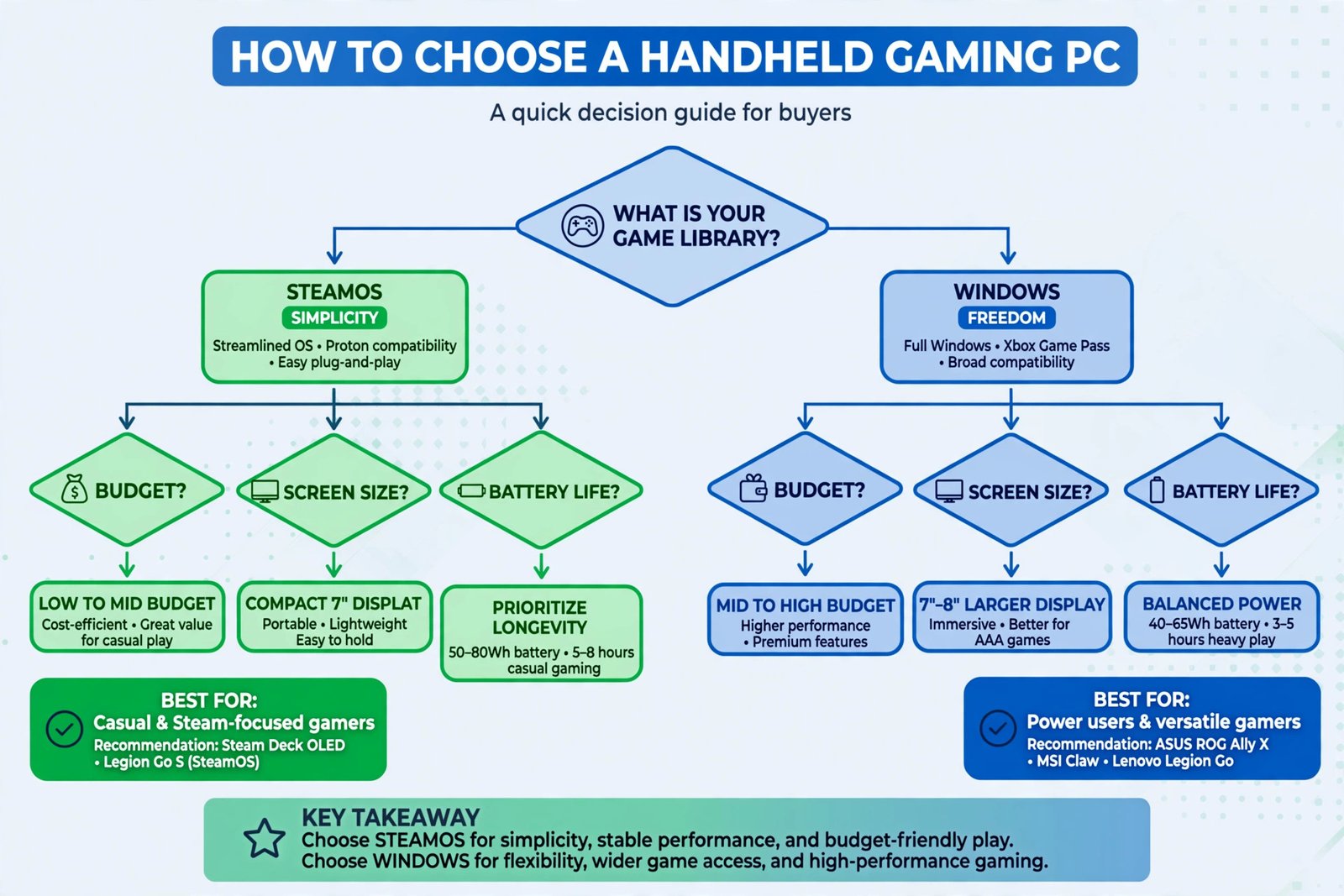
- Most of your games are on Steam and you want the simplest experience: Steam Deck OLED. It costs more than it used to after the 2026 price rise, but it remains the only device where everything just works.
- You want Windows, Game Pass, and every launcher, with the best software experience: ROG Xbox Ally X20. The new OLED screen removes the last reason to hesitate, and the Xbox shell is the most controller-friendly Windows has ever been on a handheld.
- You want SteamOS with a bigger, sharper screen: Legion Go S (SteamOS). Prioritize the Z1 Extreme configuration with 32GB of RAM if the price is close to the base model, and accept the smaller battery.
- You want the biggest battery and an Intel chip for better efficiency: MSI Claw 8 AI+. The 80Wh battery and Thunderbolt 4 docking make it the best travel companion of the Windows group.
- You want the best screen and detachable controllers, price permitting: Legion Go 2. Buy it only at a sane street price. If Lenovo’s official pricing is anywhere near recent levels, put that money toward a gaming laptop instead.
If you are buying one as a gift this holiday season, our tech gifts guide has more ideas in the same budget range.
The ones we cut, and why
Honesty requires naming what did not make the list. The ROG Ally X (2024) was a great device, and ASUS still lists it at $799.99, but production has wound down and the official store shows it out of stock. It has been superseded twice over. The ROG Xbox Ally X (2025) launched at $999.99 and was a solid machine, but the X20 replaced it within a year with a much better screen, so recommending the older one makes little sense. The original MSI Claw from 2024 is discontinued and thoroughly outclassed by the Claw 8 AI+. And the Windows version of the Legion Go S is not a bad device, it simply did not earn its own slot when the SteamOS version is the more distinctive pick; consider it as an alternative to the Go S above if you need Game Pass on that hardware.
In 2026, the handheld you buy matters less than the operating system you live with. Pick SteamOS for simplicity, pick Windows for freedom, and let the price checks above keep you from overpaying in a volatile market.

- iPhone Duo: Should You Buy Apple’s First Foldable? - October 16, 2026
- Best Handheld Gaming PCs in 2026: Steam Deck, ROG Ally, and Legion Go - October 16, 2026
- How to Turn Off iOS Connectivity Assist (and When You Should Leave It On) - October 15, 2026