
Apple’s first foldable iPhone sold out its launch-day stock within about half an hour of pre-orders opening. If you are deciding whether to buy the iPhone Duo, the first question is no longer about specs. It is about patience: order now and you will probably wait around a month, with new orders currently estimated to arrive in December.
This guide lays out what is actually happening with stock, what the iPhone Duo costs, what you give up, and who should buy now versus who should wait. Prices below were verified on October 16, 2026.
Pre-orders are open, but launch-day delivery is already gone
Pre-orders opened on October 16 at 5:00am PT (8:00am ET) in more than 70 countries and regions, according to MacRumors’ pre-order coverage, and the response was immediate. Within half an hour, delivery estimates for every configuration had slipped to January 25, 2027, and only the earliest buyers received a phone on the October 23 retail launch day. Supply has improved since then: by mid-November, new orders placed through Apple’s online store were quoted December 16 to 23, and the latest estimates run about four to five weeks. Existing pre-orders have been pulled forward too, with many January dates moved into December. Check the estimate shown at checkout before you commit, because it still moves in both directions.
Here is what that means for your options right now:
- Order online today: Expect delivery around January 25, 2027, based on current estimates. Delivery dates can improve as Apple ramps production, but they can also slip further.
- Try a walk-in or in-store pickup: Apple Stores may hold walk-in stock, but expect it to be tight, and Apple’s online store was showing no in-store pickup availability in mid-November. Check the Apple Store app on the day rather than assuming stock is there.
- Check carriers: AT&T, T-Mobile, and Verizon are accepting pre-orders and may hold separate stock allocations from Apple. Carrier trade-in deals are available, but read the fine print before committing.
- Skip the scalpers: launch-week eBay listings asked up to about $5,200, more than double the base price. With delivery estimates now down to weeks rather than months, paying a scalper markup makes even less sense than it did on day one.
Apple has not disclosed production figures or a date for supply meeting demand, and its chief executive has said only that the company is working to get the Duo to as many customers as quickly as possible. The complex folding panels and the hinge are the constraint, and this is still a limited first run, but the wait has already shortened by more than a month since launch day.
What the iPhone Duo actually is
The iPhone Duo is Apple’s first foldable smartphone. Closed, it is a compact phone with a 5.4-inch outer display. Open it like a book and it becomes a 7.6-inch tablet-class device with an iPad-like aspect ratio. Both screens are OLED with 120Hz ProMotion and up to 3,000 nits of peak brightness. The inner display uses a matte nano-texture finish designed to hide the crease, and an Apple hardware executive has publicly said to hold Apple accountable on how the crease holds up over time.
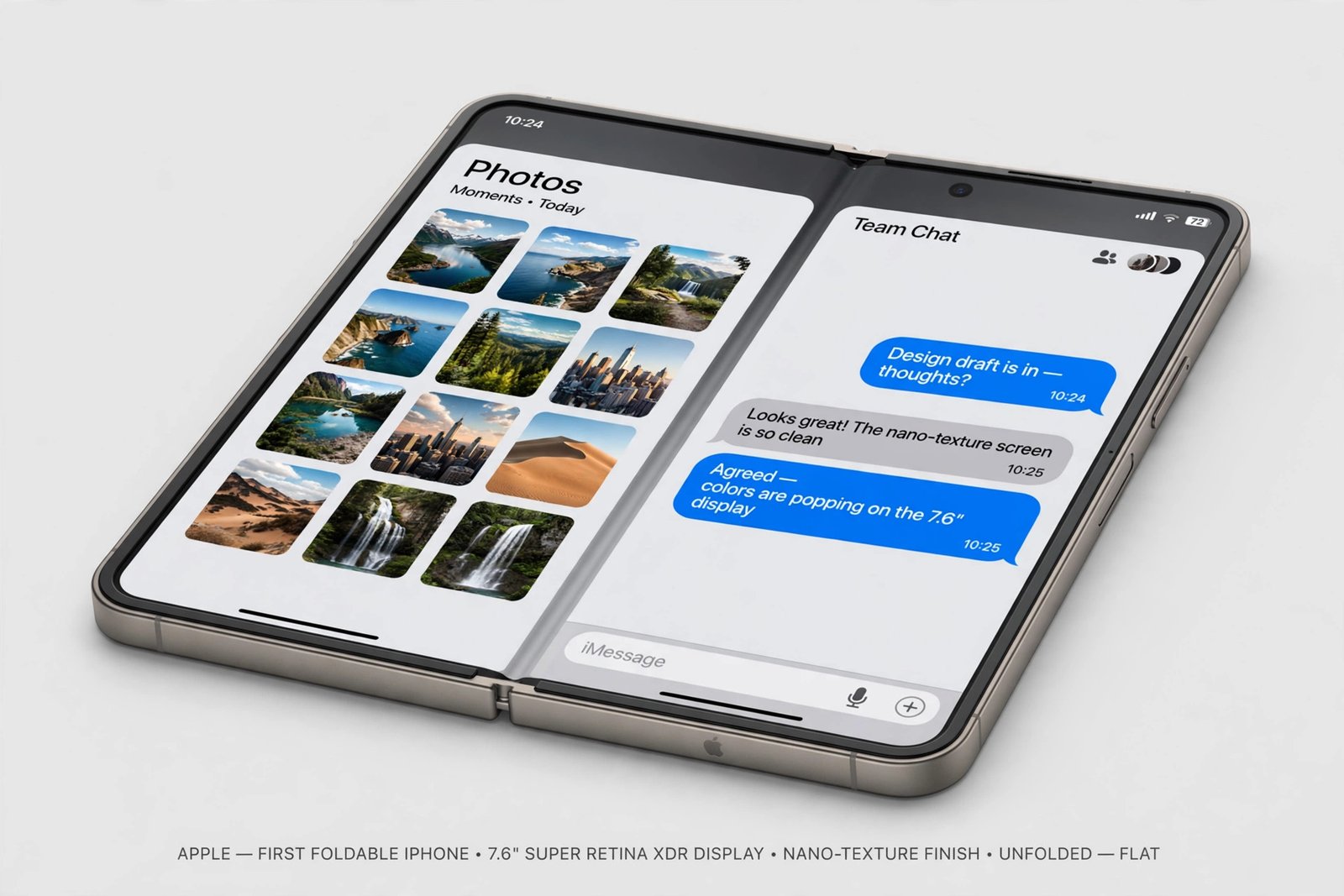
Key specs at a glance
| Inner display | 7.6-inch folding OLED, 120Hz ProMotion, 3,000 nits peak, matte nano-texture |
| Outer display | 5.4-inch OLED, 120Hz ProMotion, 3,000 nits peak |
| Chip | A20 Pro (2nm), 6-core CPU, 7-core GPU, 12GB RAM |
| Cameras | 48MP Fusion Main + 48MP Fusion Ultra Wide (up to 2x optical-quality zoom), 12MP Center Stage front camera in outer display |
| Biometrics | Touch ID in the side button (no Face ID) |
| SIM | eSIM only, no physical SIM tray |
| Build | Grade 5 titanium frame, Ceramic Shield front and back, IP68 |
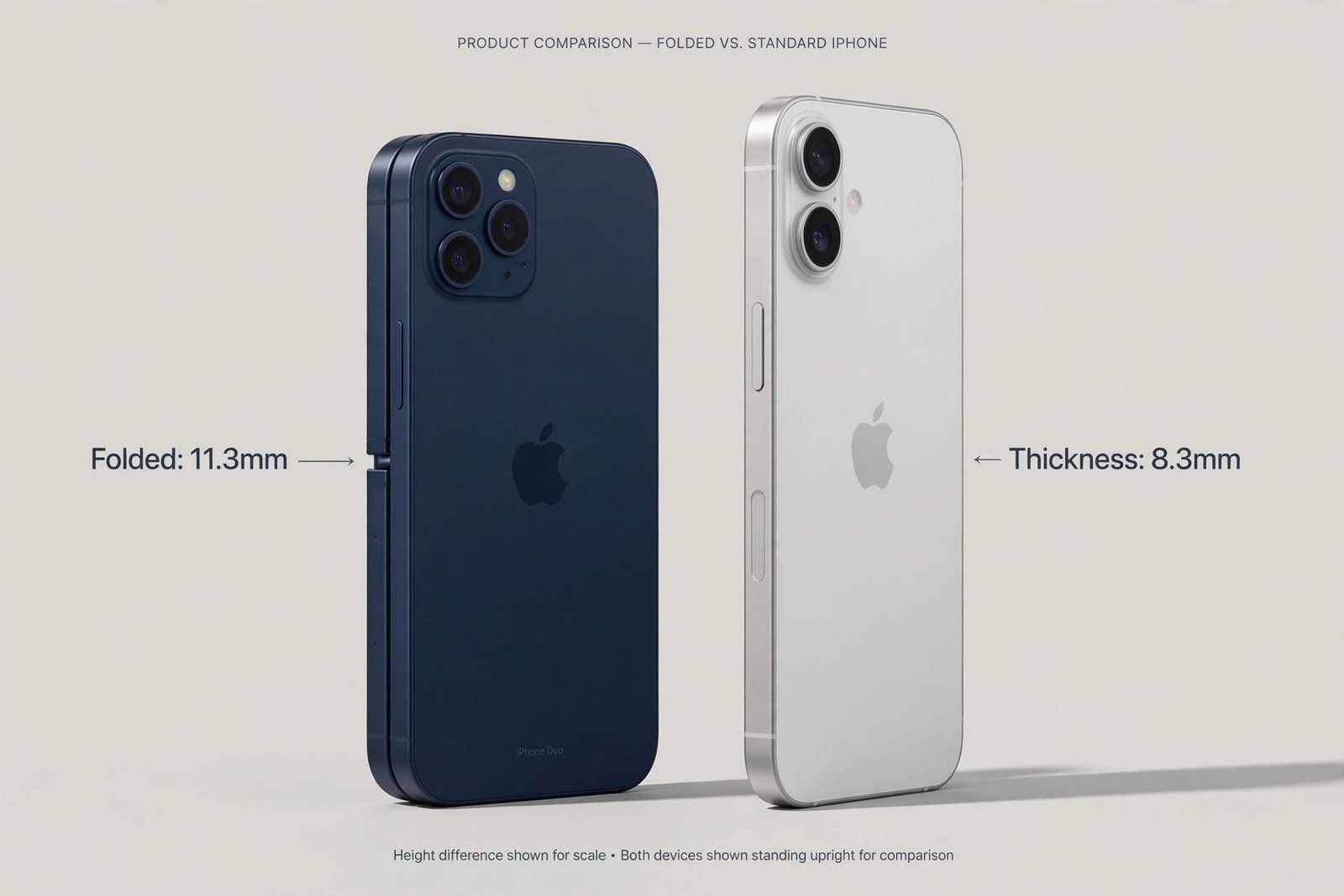
| Size and weight | 5.2mm open, 11.3mm closed, 254g |
| Battery | Dual-battery design, up to 31 hours of video playback on the inner display and 44 hours on the outer display |
| Colors | Night Sky, Star White |
Two trade-offs deserve attention. First, there is no Face ID: the fingerprint sensor is built into the side button, and you will need to adjust if you unlock and pay with your face all day. Second, there is no dedicated telephoto lens: the two-lens system maxes out at 2x optical-quality zoom, so long-range photography fans lose reach. Also note the iPhone Duo is eSIM only worldwide, so if you still rely on a physical SIM, you will need to convert it. Our guide to activating eSIM on iPhone walks through that process step by step.
Apple Pencil support is now live. It arrived with iOS 27.2 on October 26, days after launch, and it works with the Apple Pencil (USB-C) only, which costs $79. The Pencil Pro and older Pencil models do not work with the Duo, so check which model you own before buying one for it.
What it costs
US pricing, verified October 16, 2026:
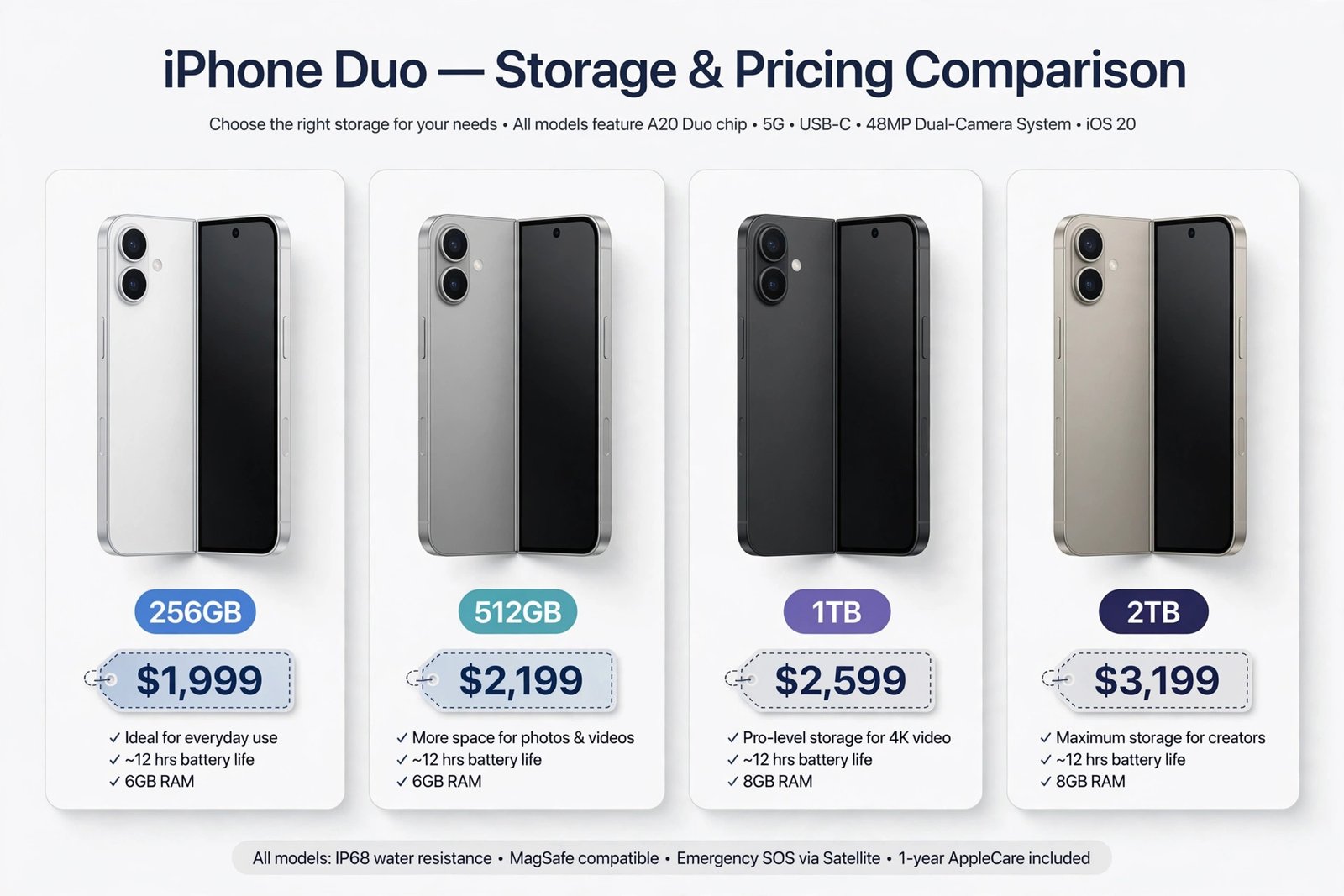
| Storage | Price |
| 256GB | $1,999 |
| 512GB | $2,199 |
| 1TB | $2,599 |
| 2TB | $3,199 |
In the UK, the 256GB model starts at £1,999. If the sticker price stings, there are ways to soften it. Apple offers trade-in credit of $175 to $885 for an eligible iPhone 13 or newer, and carriers are advertising up to $1,200 off with a qualifying trade-in and plan. Financing options include Apple Card monthly installments, about $83.29 a month over 24 months for the base model. If anything in this article’s pricing is out of date by the time you read it, check the current price on Apple’s official page.
One cost that is easy to overlook: protection. Without a plan, an out-of-warranty inner display replacement runs about $999, according to repair specialists who tore the phone down, thanks to the folding display and complex hinge. AppleCare+ is worth serious consideration on a first-generation foldable.
Who should buy it now
Early adopters who accept first-gen risk. This is the first foldable iPhone, and it will feel like one. If new hardware excites you more than it worries you, and you have the budget, being early is the point.
Heavy multitaskers. The whole case for the Duo is the 7.6-inch inner screen. Split View lets you run two apps side by side, and iOS 27.1 adapts as the phone folds, rotates, and flips. If you regularly answer messages while referencing a document, plan travel while watching a video, or read long PDFs on your phone, the unfolded display is a genuine upgrade over any regular iPhone.
People upgrading from an old iPhone. Coming from an iPhone 13 or 14, everything about the Duo is a leap: the A20 Pro, the cameras, the displays, the battery life. Your trade-in value also helps offset the price. Set the phone up properly with our 12 iPhone settings to change on iOS 27 once it arrives.
Who should wait
Face ID loyalists. If you unlock your phone, approve payments, and sign into apps with your face dozens of times a day, losing Face ID is a daily friction you should not underestimate. Touch ID in the side button works fine, but it is a change in rhythm, not just a change in hardware. There is a partial fix on the way: iOS 27.3, in public beta and expected in December, adds an Unlock with Front Camera option that lets the outer camera unlock the closed phone. It is not Face ID, it works only on the lock screen of the closed phone, and Touch ID is still required for Apple Pay, passwords, and apps.
Telephoto photographers. The Duo has no dedicated telephoto lens and tops out at 2x optical-quality zoom. If you shoot concerts, sports, wildlife, or your kids from the back row, the regular iPhone 18 Pro line with its telephoto camera is the better camera purchase.
Price-sensitive buyers. At $1,999 minimum, the Duo costs roughly twice a standard flagship iPhone. Most people do not need a folding display, and the regular iPhone lineup does everything else at a much lower price. Waiting also tends to bring price drops and better trade-in values.
First-generation durability skeptics. Folding displays have a history: visible creases over time, hinge wear, expensive repairs. Apple has engineered a matte nano-texture finish and a 100-plus-component hinge to address this, and an Apple VP has publicly invited scrutiny, but the Duo’s long-term durability is unproven in the real world. If you keep phones for four or five years, waiting for real-world reports or a second generation is the sensible move.
What launch month taught us: the screen cracking reports
Within days of the October 23 launch, some early owners reported cracks and bright lines appearing along the inner display near the hinge, in some cases during the first few days of use. Apple responded on October 26, saying a small number of units are affected and telling anyone with the problem to contact AppleCare for a replacement. The company has not given a failure rate, and there is no recall.
What this means for a buyer is practical, not theoretical. The reported faults show up fast, so if your Duo’s inner screen survives its first week of normal folding, yours is very likely fine. Check the inner display closely in the first days, fold it normally rather than forcing it, and keep grit away from the hinge: one durability test found dust getting into the hinge despite the IP68 rating. Early reviewers also report that Touch ID can be less reliable than on a regular iPhone, and that some third-party apps have not yet adapted to the folding screen. And remember the repair math from the section above. A $999 screen bill is the real cost of this being a first-generation foldable.
The bottom line
The iPhone Duo is an impressive piece of hardware and a genuinely new category for Apple, but the first month has also shown its first-generation edges: a small number of inner displays have cracked near the hinge, and Apple is replacing affected units. Demand still exceeds supply, but the wait has shortened a lot. A new order now is likely to arrive in December, not January, and walk-in stock remains tight and unpredictable.
Buy now if you are an early adopter, a heavy multitasker who will use the big screen daily, or an old-iPhone owner ready for a leap, and accept the delivery wait. Wait if Face ID or a telephoto lens is non-negotiable, if the price is a stretch, or if you prefer to let first-generation hardware prove itself. Either way, skip the scalpers. Paying double for impatience is the one decision this guide can settle for you.
Decide based on your hands, not the hype. If the folding screen solves a real problem in your day, join the wait list. If it just looks cool, wait for the price and the proof.

- How to Install Ubuntu 24.04 LTS Step by Step (Dual-Boot Guide) - November 27, 2026
- How to Run Local AI Models on Your PC With Ollama (Step-by-Step Guide) - November 26, 2026
- How to Use Remote Desktop on Windows 11 (Step-by-Step Guide) - November 25, 2026