
Picking a handheld gaming PC in 2026 has less to do with specs than it used to. Every serious device on this list runs the same Steam library, and the differences that matter are the ones you feel every day: whether the device wakes from sleep instantly, whether your games live in Steam or across five launchers, and how much you are willing to pay for a nicer screen. Here is a shortlist of five devices that are actually current, with prices verified on November 25, 2026, in Black Friday week, and an honest look at the ones that did not make it.
The deciding factor: SteamOS or Windows
Before comparing hardware, decide which camp you belong to. SteamOS, which powers the Steam Deck and the Lenovo Legion Go S (SteamOS), behaves like a console. You press the power button and your game resumes exactly where you left it, updates happen quietly in the background, and everything is built for a controller. Windows handhelds behave like a laptop. You get the full desktop, which means native Xbox Game Pass, the Epic Games Store, GOG, Battle.net, and every mod and utility that assumes Windows. The tradeoff is Windows itself: standby battery drain, update prompts at bad times, and menus that clearly were not designed for a 7-inch screen.
There are also hard compatibility lines. Many competitive multiplayer games with kernel-level anti-cheat, like some Call of Duty and Valorant-style titles, do not run on SteamOS. If those are your main games, Windows is not optional. If your library is mostly single-player and indie games from Steam, SteamOS is the calmer daily experience.
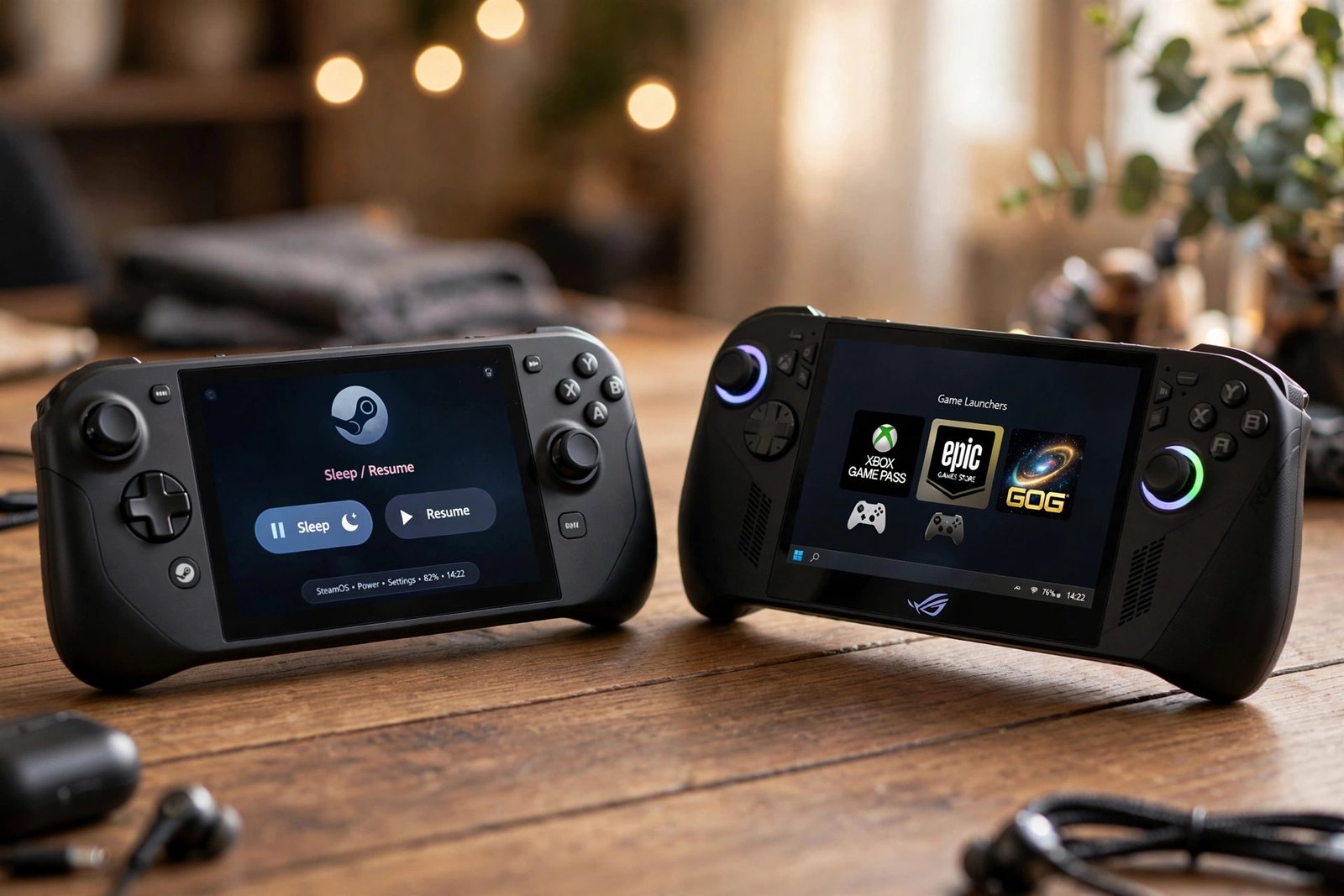
The shortlist: five handhelds worth buying in 2026
Four manufacturers, two operating systems, and prices that moved sharply this year because memory and storage costs surged. Every price below was checked on November 25, 2026, either on the official store page or against current official listings. Black Friday deals are live, so treat the sale prices as this week’s numbers, not permanent ones.
Steam Deck OLED: still the simplest pick
The Steam Deck remains the benchmark everything else is measured against, and Valve kept its crown by doing less. The 7.4-inch HDR OLED display at 1280 by 800 and 90Hz still looks gorgeous, the custom AMD APU with 16GB of RAM handles the vast majority of the Steam catalog through Proton, and suspend and resume works so reliably you will take it for granted within a week. The one shock is the price. Valve raised prices on May 27, 2026, citing memory and storage costs: the 512GB model now costs $789 and the 1TB model costs $949 on the Steam store page (price checked 2026-11-25 against Valve’s May 2026 revision). Valve has announced no Black Friday discount on Deck hardware, and its refurbished units, listed at $629 for 512GB, have been out of stock since mid-October, so check Valve’s store before planning around one.
ROG Xbox Ally X20: the best Windows handheld experience
ASUS launched this device on October 15, 2026, the day before this article, so it is literally the newest option here. The X20 is the successor to the 2025 ROG Xbox Ally X, and it fixes the biggest complaint about that device: the screen is now a 7.4-inch ROG Nebula HDR OLED at 1080p and 120Hz with FreeSync Premium Pro, up from IPS. The internals stay strong with a Ryzen AI Z2 Extreme chip, 24GB of LPDDR5X memory, a 1TB SSD, and an 80Wh battery. Early reviews agree on one point: the $300 over the $999.99 ROG Xbox Ally X buys the OLED screen, the new magnetic sticks, and the see-through shell, not speed, with benchmark scores effectively identical between the two. Microsoft also took its Automatic Super Resolution upscaling out of preview for the Ally X and X20 on November 10, 2026. It runs Windows 11 under the Xbox full-screen experience, a controller-first shell that aggregates Steam, Battle.net, and Game Pass into one library view while keeping the full Windows desktop available underneath. Standalone pricing is $1,299.99 according to ASUS’s official launch announcement (price checked 2026-11-25). There is also a $2,499.99 anniversary bundle with AR glasses and a Pelican case, but most buyers will want the standalone unit.
Lenovo Legion Go S (SteamOS): the bigger Steam Deck
If you like the Steam Deck but want a larger screen and stronger hardware, this is the closest thing to a bigger Deck that officially runs Valve’s operating system. The Legion Go S pairs an 8-inch 1920 by 1200 IPS display at 120Hz with VRR against either a Ryzen Z2 Go chip or, in the higher-tier configuration, a Ryzen Z1 Extreme with 32GB of RAM and 1TB of storage. SteamOS on non-Valve hardware works the way it does on the Deck, including the excellent suspend and resume. Two cautions. First, the 55.5Wh battery is the smallest here, so expect roughly two to two and a half hours of heavy gaming. Second, pricing is messy: Lenovo lists the Z1 Extreme 32GB and 1TB SteamOS model at $1,607.99, but its Black Friday price is $869.99 on lenovo.com, and Best Buy has it at $899.99 (price checked 2026-11-25). The slower Z2 Go base model is a worse deal at $749.99 on sale, so buy the Z1 Extreme version if the prices are close. Shop around before you buy. A Windows version of the Go S also exists for buyers who want this hardware with Game Pass.
MSI Claw 8 AI+: the Intel alternative with the big battery
MSI is the only major brand betting on Intel for handhelds. The Claw 8 AI+ runs a Core Ultra 7 258V Lunar Lake chip with Intel Arc 140V graphics, 32GB of fast LPDDR5x memory, a 1TB SSD, and an 8-inch 1920 by 1200 IPS display at 120Hz with VRR. It has the largest battery class in the shortlist at 80Wh, two Thunderbolt 4 ports for easy docking, Hall effect sticks that resist drift, and it runs full Windows 11. MSI’s own store now lists it at $1,299.99, but Black Friday pricing brings it to $999.99 at Best Buy and $1,049 at B&H (price checked 2026-11-25), so do not pay the summer prices. Note that MSI also sells a pricier Claw 8 EX AI+ with Intel’s newer Arc G3 silicon, at $1,499 for the standard Arc G3 model and $1,799 for the Arc G3 Extreme; that is a halo product, and the standard AI+ remains the sensible Claw to buy.
Lenovo Legion Go 2: the premium screen, at a volatile price
The Legion Go 2 is the most complete handheld on paper: an 8.8-inch OLED display at 1920 by 1200 and 144Hz with VRR, a Ryzen Z2 Extreme chip, 32GB of LPDDR5X memory, a 74Wh battery, and detachable TrueStrike controllers with Hall effect sticks and an FPS mode that turns one controller into a mouse. It is also the hardest to recommend at official pricing right now. The range launched from $1,099.99 for the Ryzen Z2 model in late 2025, but Lenovo’s official listings have swung wildly in 2026; in November 2026 the Z2 Extreme model with 32GB and 1TB is $1,999.99 at Best Buy, up from its $1,349.99 launch price, and the top 2TB configuration was listed above $3,000 and marked as unavailable for purchase (price checked 2026-11-25). The same machine sold for $999.99 at Costco in October, so waiting for a sane price is the right move. If you find one at a sane street price, it is the best screen you can get on a handheld PC. At list price, this much money buys a genuinely capable gaming laptop, and our roundup of prebuilt gaming PCs is worth a look before you spend it.

Spec comparison: price, display, performance, battery
All five devices are real handheld PCs that run your Steam library. They separate on display quality, battery size, weight, and of course price. Prices were checked November 25, 2026.
| Device | Price (USD, checked 2026-11-25) | Display | Chip and RAM | Battery | Weight | OS |
|---|---|---|---|---|---|---|
| Steam Deck OLED | $789 (512GB) / $949 (1TB) | 7.4 in OLED, 1280 x 800, 90Hz | Custom AMD APU, 16GB | 50Wh | 640g | SteamOS |
| ROG Xbox Ally X20 | $1,299.99 | 7.4 in OLED, 1920 x 1080, 120Hz | Ryzen AI Z2 Extreme, 24GB | 80Wh | 756g | Windows 11, Xbox full-screen |
| Legion Go S (SteamOS) | $869.99 Black Friday, list $1,607.99 | 8 in IPS, 1920 x 1200, 120Hz, VRR | Ryzen Z1 Extreme or Z2 Go, 16-32GB | 55.5Wh | About 740g | SteamOS |
| MSI Claw 8 AI+ | $1,299.99 list, $999.99 Black Friday | 8 in IPS, 1920 x 1200, 120Hz, VRR | Intel Core Ultra 7 258V, 32GB | 80Wh | 793g | Windows 11 |
| Legion Go 2 | From $1,099.99 launch; $1,999.99 street | 8.8 in OLED, 1920 x 1200, 144Hz, VRR | Ryzen Z2 Extreme, 32GB | 74Wh | Heaviest of the five | Windows 11 |
SteamOS vs Windows: what changes in daily use
Specs tell you what a device can do. The operating system tells you how it feels to use it every day. Here is how the two camps compare on the things that actually come up.
| Everyday task | SteamOS (Steam Deck, Legion Go S) | Windows (Ally X20, Claw 8 AI+, Legion Go 2) |
|---|---|---|
| Sleep and resume | Press power, game resumes instantly, very reliable | Hit or miss, some games break on resume, battery drains in standby |
| Xbox Game Pass | Cloud streaming only, no native app | Full native app, downloads and cloud both work |
| Epic, GOG, itch.io games | Possible through tools like Heroic, extra setup required | Native installers, works out of the box |
| Anti-cheat multiplayer | Many titles unsupported, check each game | Full compatibility |
| Updates | Quiet, console-style, rarely interrupts | Can arrive at the worst moment, needs managing |
| Tinkering and mods | Desktop mode available but secondary | Full desktop, mods and utilities just work |
The pattern is consistent across every device we have covered. SteamOS owners spend their time playing. Windows handheld owners spend a little of their time maintaining, in exchange for access to everything. Neither is wrong; it depends on whether you would rather optimize or just press play. The Xbox full-screen shell on the Ally X20 closes the gap more than any previous attempt, but it is still Windows underneath.
Which one should you buy
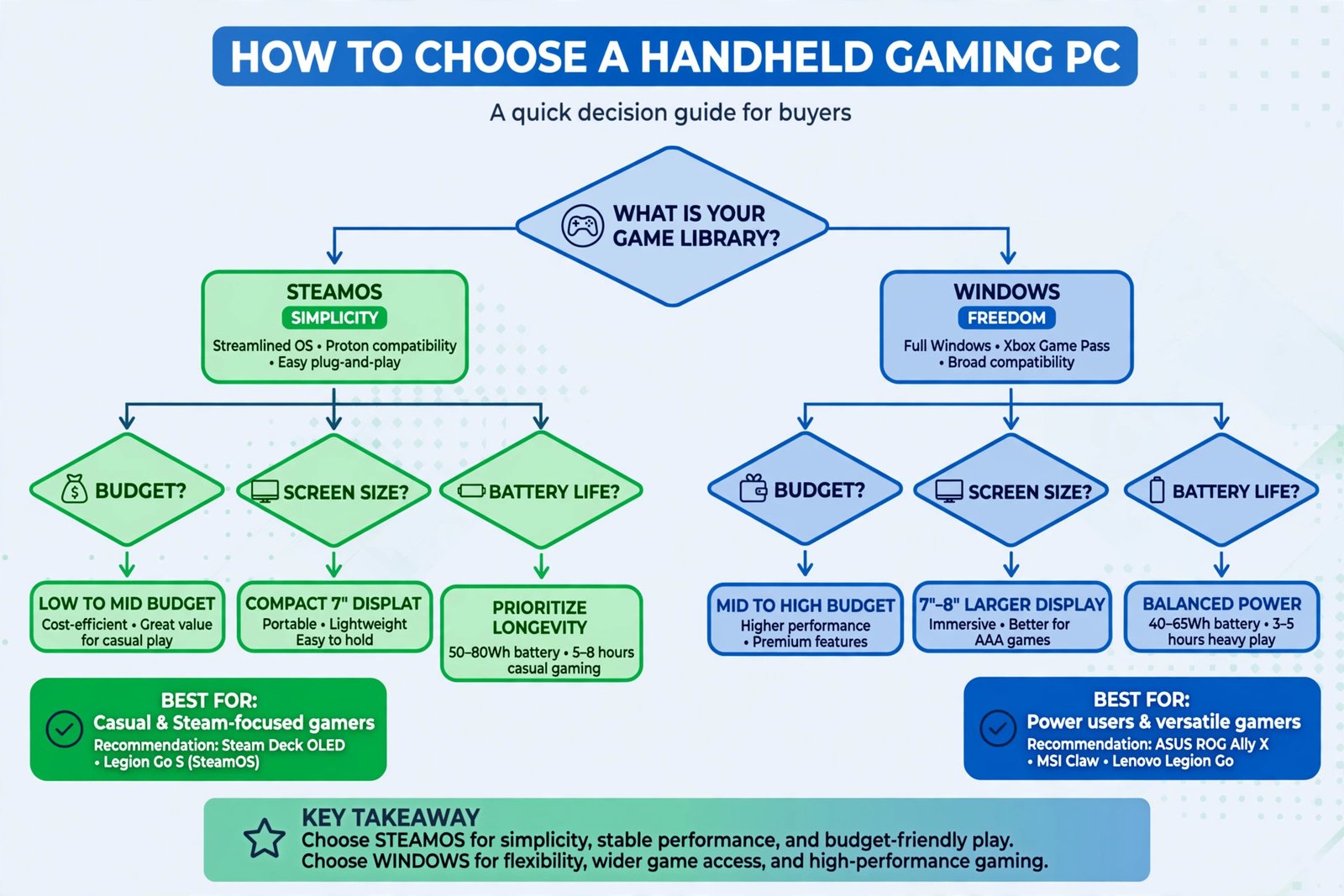
- Most of your games are on Steam and you want the simplest experience: Steam Deck OLED. It costs more than it used to after the 2026 price rise, but it remains the only device where everything just works.
- You want Windows, Game Pass, and every launcher, with the best software experience: ROG Xbox Ally X20. The new OLED screen removes the last reason to hesitate, and the Xbox shell is the most controller-friendly Windows has ever been on a handheld. If the screen is not worth $300 to you, the $999.99 ROG Xbox Ally X gives you the same performance for less.
- You want SteamOS with a bigger, sharper screen: Legion Go S (SteamOS). Prioritize the Z1 Extreme configuration with 32GB of RAM if the price is close to the base model, and accept the smaller battery.
- You want the biggest battery and an Intel chip for better efficiency: MSI Claw 8 AI+. The 80Wh battery and Thunderbolt 4 docking make it the best travel companion of the Windows group.
- You want the best screen and detachable controllers, price permitting: Legion Go 2. Buy it only at a sane street price. If Lenovo’s official pricing is anywhere near recent levels, put that money toward a gaming laptop instead.
If you are buying one as a gift this holiday season, our tech gifts guide has more ideas in the same budget range.
The ones we cut, and why
Honesty requires naming what did not make the list. The ROG Ally X (2024) was a great device, and ASUS still lists it at $799.99, but production has wound down and the official store shows it out of stock. It has been superseded twice over. The ROG Xbox Ally X (2025) is still on sale at $999.99, and it is the smarter buy for most Windows handheld shoppers: it has the same chip, memory, storage, and battery as the X20, with a 7-inch IPS screen instead of the OLED, so the X20’s $300 premium pays for the screen and controls alone. If the OLED screen is not worth $300 to you, buy the Ally X. The original MSI Claw from 2024 is discontinued and thoroughly outclassed by the Claw 8 AI+. And the Windows version of the Legion Go S is not a bad device, it simply did not earn its own slot when the SteamOS version is the more distinctive pick; consider it as an alternative to the Go S above if you need Game Pass on that hardware.
In 2026, the handheld you buy matters less than the operating system you live with. Pick SteamOS for simplicity, pick Windows for freedom, and let the price checks above keep you from overpaying in a volatile market.

- How to Install Ubuntu 24.04 LTS Step by Step (Dual-Boot Guide) - November 27, 2026
- How to Run Local AI Models on Your PC With Ollama (Step-by-Step Guide) - November 26, 2026
- How to Use Remote Desktop on Windows 11 (Step-by-Step Guide) - November 25, 2026