
How much is a doorbuster really worth if your card details end up on a scammer’s server? Black Friday 2026 lands on November 27, with Cyber Monday following on November 30, and both days are peak hunting season for fraudsters. Every year they roll out the same tricks in shinier packaging: fake stores, too-good-to-be-true ads, and urgent messages that beg you to click before you think. This guide turns you into a scam spotter. Learn the five scams to watch, the red flags that give each one away, and a quick safety check to run before any purchase.
The 5 scams to watch in 2026
Researchers documented a sharp rise in fake online storefronts and brand-impersonation phishing in the weeks before Black Friday 2025, with Amazon the most copied brand. Expect the same playbook this year, sharpened by AI-generated ads and sites that look polished enough to fool even careful shoppers. Here is what each scam looks like in the wild, and the giveaway signs to watch for.
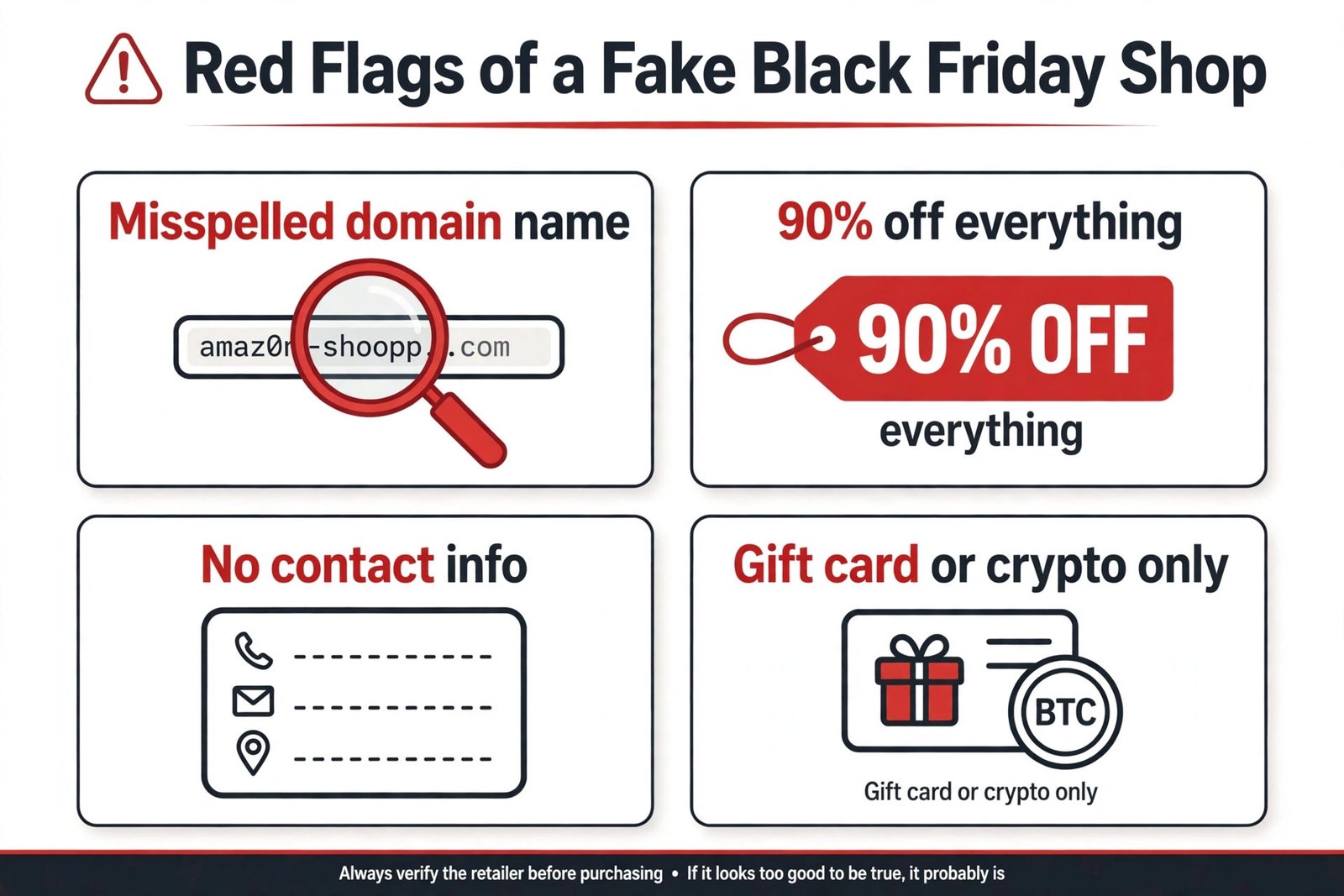
1. The lookalike store
You click a sponsored result and land on a site that looks exactly like a big retailer. The logo is right, the layout is familiar, and the deals are enormous. But the address bar reads something like “amaz0n-deals-shop.com” instead of the real store. This is a spoofed storefront: you pay, the scammers harvest your card details, and either nothing arrives or a cheap knockoff shows up weeks later.
- Misspelled or odd domain. Swapped letters, extra words, or a strange ending like .shop or .top where you expected .com.
- Brand-new site. No reviews anywhere, no social media history, no “about us” page worth the name.
- No way to reach a human. No phone number, no physical address, no return policy. Legitimate stores want you to find them. Scam stores do not.
2. The 90%-off social media bait ad
Scrolling your feed, you see an ad for a premium gadget or designer bag at a price that makes no sense: 90% off, today only. Sometimes the ad pretends a “disgruntled employee” leaked a secret discount code. Clicking leads to a fake checkout page that exists for one purpose, to take your money and payment details. The FTC warned in its November 2025 holiday alert that scammers flood social media with exactly these ads for brand-name products at unreal prices.
- An impossible discount. Real Black Friday discounts on premium tech run 10 to 40%. Ninety percent off is bait, not a sale.
- Extreme urgency. Countdown timers, “only 3 left,” and threats that the deal dies in minutes are designed to stop you from thinking.
- A store you have never heard of. Never trust an ad’s link. Go to the retailer’s real site yourself and check whether the deal exists there.
3. The “problem with your delivery” text
A text arrives claiming to be from USPS, UPS, or FedEx: your package could not be delivered, click here to reschedule or pay a small fee. Because you are genuinely expecting parcels, it feels real. The link opens a page that steals your login details or card number, and sometimes installs malware on your phone. These delivery scams have been among the most common fraud types reported to the FTC in recent holiday seasons.
- You never signed up for alerts from that number. Real carriers only text you if you opted in to tracking updates.
- A link that does not match the carrier’s real site. Look closely at the URL before tapping anything.
- A demand to “verify” or pay a fee. Carriers do not ask for card details over text to release a package.
If your phone fills up with these messages, blocking and reporting them helps. Spam call blocker apps can filter many scam calls and texts before they reach you.
4. The gift-card-or-crypto checkout
You find a small store with fair prices and add something to the cart. At checkout, the only payment options are gift cards, wire transfer, Zelle, or crypto. That is not a quirk. It is the scam. These payment methods are nearly impossible to reverse, which is exactly why fraudsters demand them. The FTC’s holiday shopping guidance is blunt: if a seller says you can only pay with a gift card, wire transfer, payment app, or cryptocurrency, it is probably a scam. Crypto payment demands follow the same playbook as NFT rug pulls, where the money disappears the moment you send it.
- Credit card is missing from the options. Legitimate stores almost always accept cards.
- A discount for paying “the fast way.” Extra savings for gift-card payment are a bribe, not a perk.
- Pressure to pay off-site. Moving the deal to a chat app or email to “complete payment” dodges every protection a marketplace offers.
5. The five-star fraud: fake reviews and fake markdowns
Some scams never leave the real stores. A no-name listing on a marketplace shows 4.9 stars across thousands of identical-sounding reviews, all posted within a few days. Or a “Black Friday deal” advertises 60% off a price that was quietly raised the week before. Both tricks manufacture trust: the reviews make a junk product look proven, and the fake markdown makes a normal price look like a steal.
- Reviews that read like copies of each other. Sort by the worst reviews first. Real products have a mix of opinions; scams have suspiciously uniform praise.
- A “was” price you cannot verify. Check the price history with a tracker or Chrome’s built-in price insights before trusting any markdown.
- A seller account with no history. A shop created last month selling hundreds of five-star products is a red flag, not a success story.
The 60-second safety check before you buy
Before you enter any payment details on a store you found through an ad, search result, or social media post, run this three-step check. It takes about a minute and it defeats nearly every scam on this list.
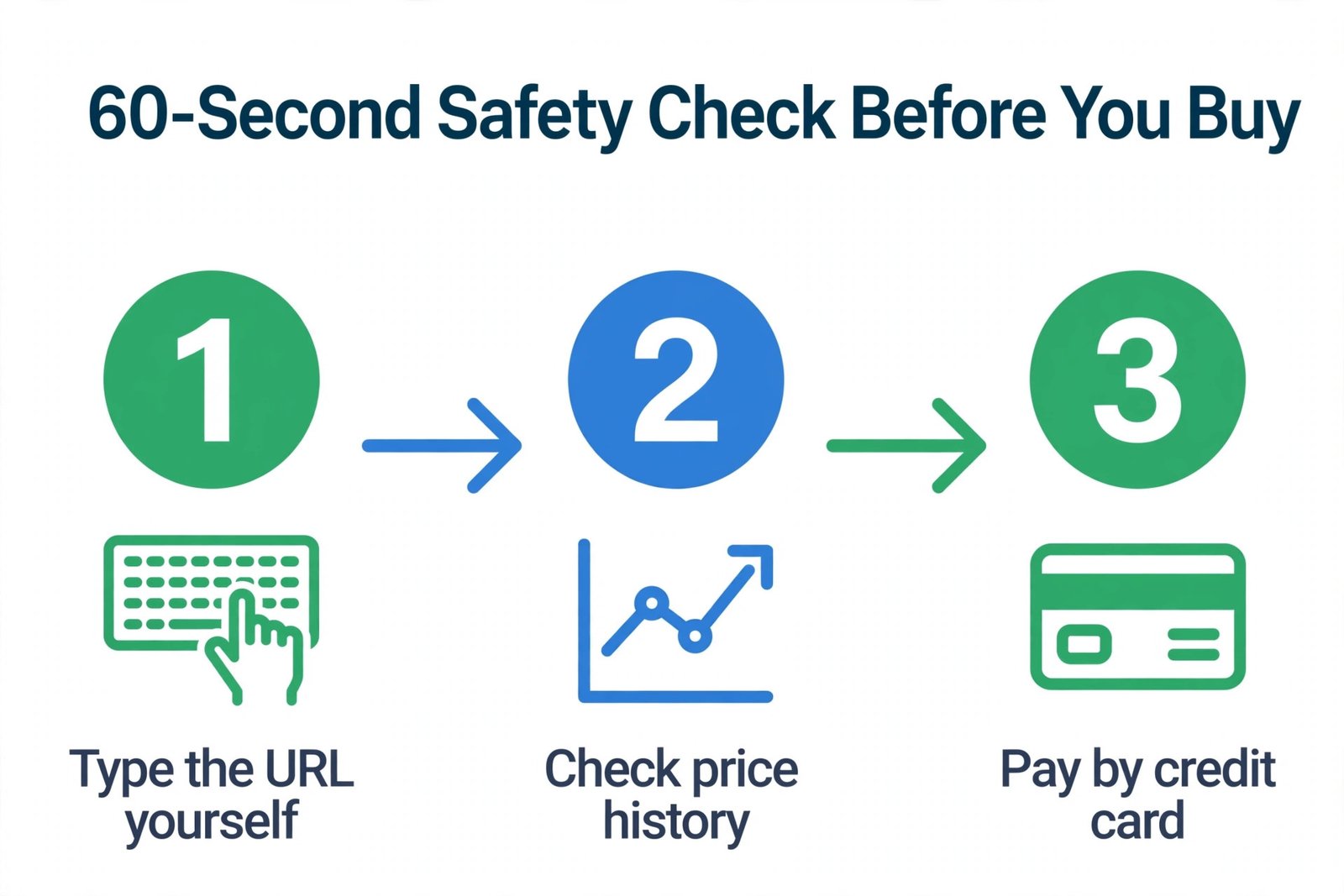
- Type the store’s address yourself. Do not click the link in the ad, email, or text. Open your browser and type the retailer’s real website address, or use its official app. If the deal is real, it will be there. This single habit blocks most phishing.
- Check the price history. Use a price tracker or Chrome’s price insights to see what the item cost a month ago. A genuine deal beats the item’s recent average price. A fake one just beats an inflated “original” price.
- Pay by credit card. Cards give you the right to dispute a charge if the item never arrives or is not as described. Never pay with gift cards, wire transfers, or crypto on a store you are not sure about.
The FTC’s own advice echoes this routine: research the seller by searching its name plus words like “review,” “complaint,” or “scam,” pay by credit card when possible, and keep your receipts. You can read their full holiday shopping scam guide for more detail.
What to do if you already paid a scammer
It happens to careful people too. Scam sites in 2026 look professional enough to fool anyone, so treat this as damage control, not self-blame. Act quickly, because the sooner you move, the better your chance of recovering the money.
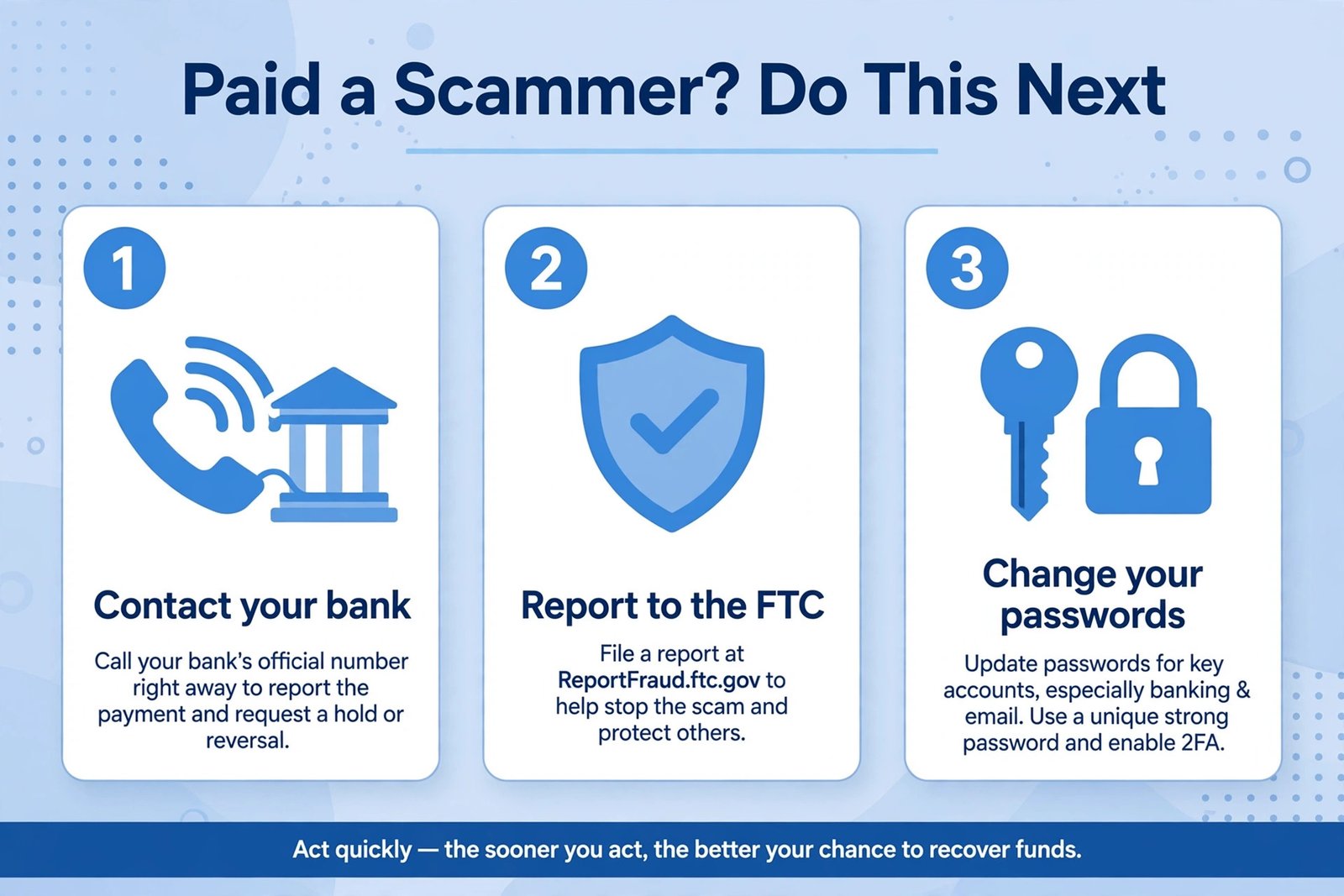
- Contact your bank or card issuer right away. Call the number on the back of your card, not any number from the suspicious site. Report the payment, ask for a hold or reversal, and request a new card number if you shared it.
- Dispute the charge. If you paid by credit card, you can dispute a charge for items that never arrived or were not as described. Keep your order confirmation and any emails as evidence.
- Report the scam. File a report at ReportFraud.ftc.gov. Your report helps the FTC spot patterns and warn other shoppers.
- Change your passwords. If you created an account on the scam site, update the password for your email and banking accounts first, especially if you reuse passwords. A password manager app makes it practical to give every account a unique, strong password.
- Watch your statements. Check your card and bank statements weekly for the next few months. Flag anything you do not recognize immediately.
The golden rule of holiday shopping: if a deal demands gift cards, wire transfers, or crypto, it is not a deal. It is a trap.
Quick rules to remember
| Scam type | Defense |
|---|---|
| Lookalike store with a misspelled domain | Type the URL yourself and check the domain letter by letter |
| 90%-off bait ad on social media | Verify the deal on the retailer’s real site before clicking anything |
| Fake delivery text or email | Never tap the link; check tracking in your original order confirmation |
| Gift-card or crypto-only checkout | Walk away and pay by credit card on a trusted store instead |
| Fake reviews and inflated markdowns | Read the worst reviews first and check the price history |
Frequently asked questions
When are Black Friday and Cyber Monday in 2026?
Black Friday 2026 is Friday, November 27, and Cyber Monday 2026 is Monday, November 30. Scam activity typically ramps up in the weeks before, so stay alert from early November onward.
Are Black Friday deals on social media safe?
Some are, but ads are the top delivery channel for shopping scams. Treat every social media ad as unproven until you verify the deal on the retailer’s official website or app, typed in by you.
What is the safest way to pay for Black Friday purchases?
A credit card. It gives you the right to dispute charges for items that never arrive or are not as described. Avoid gift cards, wire transfers, and crypto on unfamiliar stores, because those payments are nearly impossible to reverse.
What should I do if I clicked a suspicious link?
Do not enter any information. Close the page, run a scan with your security software, and change the passwords of any accounts you might have exposed. If you entered card details, call your bank and report it.

- How to Avoid Black Friday Scams in 2026: The Scam-Spotting Field Guide - October 15, 2026
- Best Mini Projectors for Movie Nights in 2026 (Under $100) - October 15, 2026
- 5 Best Smart Plugs for Holiday Lights in 2026 (Automate Christmas) - October 15, 2026