
Before you buy any NFT, run the checks below. They take about ten minutes and filter out most scams before any money leaves your wallet. This is a safety checklist, not investment advice.
Pre-checks: do these before you look at anything else
Most rug pulls fail the same basic tests. Work through this list first, and walk away the moment a project fails one badly.
- Search the project name plus “scam”, “rug”, and “review”. Previous scams from the same team or wallet address often show up in scam databases and community warnings.
- Check who is behind it. Real names, public profiles, past projects, interviews. Anonymous teams are the single most common trait of rug pulls.
- Read the actual plan, not the hype. A real project explains what it does, how the money is used, and what the roadmap is. Vague promises of “utility coming soon” are a red flag.
- Look at the community, not the follower count. Bots and paid followers are cheap. Genuine communities argue about details, ask hard questions, and get real answers from the team.
- Never invest money you cannot afford to lose. This is the one rule that survives every scam story.
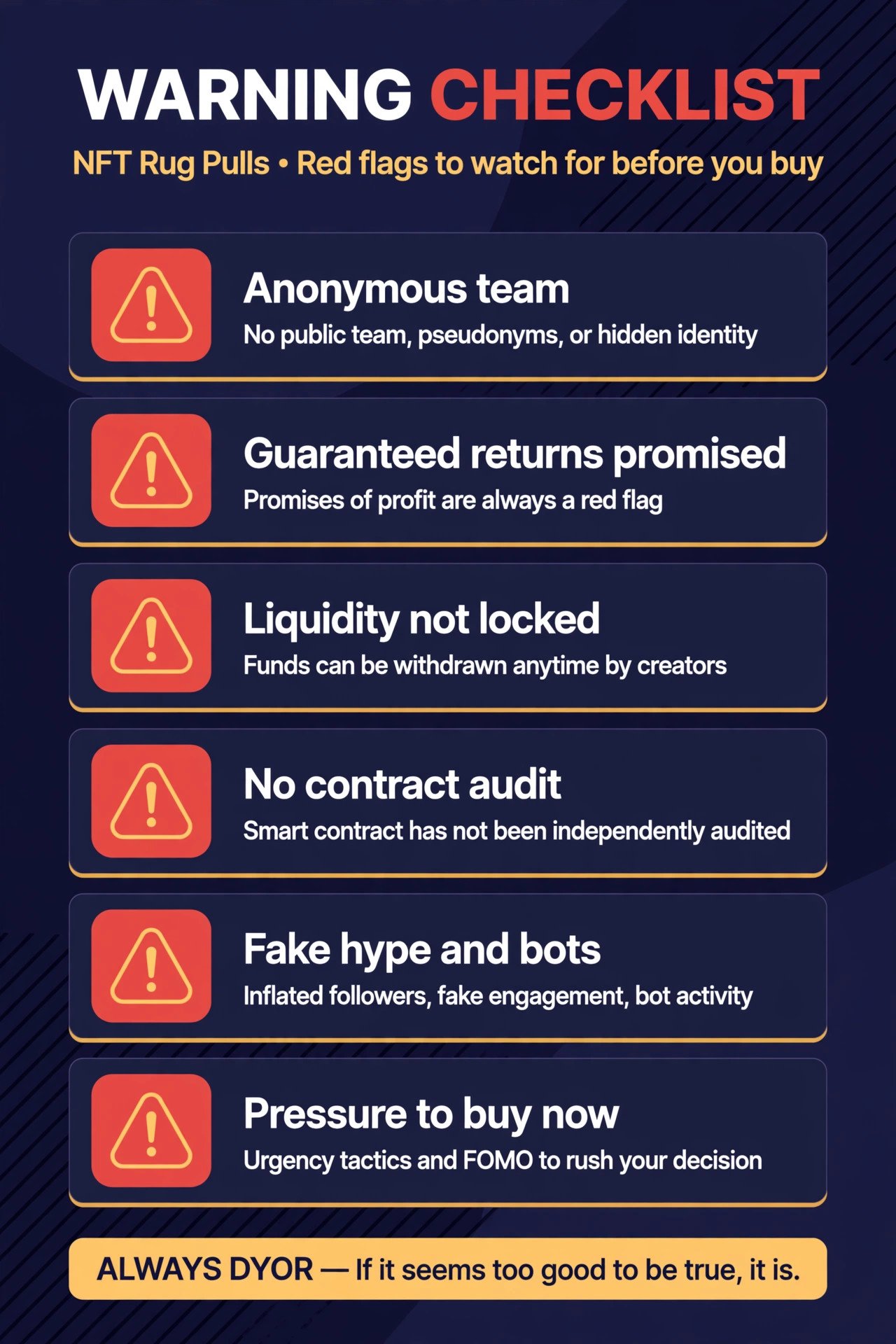
Checkpoint 1: Who is really behind the project?
Scam teams hide. Check whether the founders use real names and verifiable identities: LinkedIn profiles with history, past projects you can look up, video interviews, public appearances. In 2026, AI-generated profile photos and deepfake-style team videos have made this harder, so do not stop at a reverse image search. Look for a trail of real work over time. If the team is anonymous, the art is the only thing you can evaluate, and art alone is never a reason to trust anyone with your money. If you are new to how NFT launches work, our guide on how to find upcoming NFT whitelists explains the normal process, which makes the abnormal ones easier to spot.
Warning: “doxxed to the team” or “verified by a launchpad” is not the same as publicly known founders. Ask who verified them, and whether you can see the verification yourself.
Checkpoint 2: Can the team take the money and run?
A rug pull is, at its core, an exit. The question is whether the project’s setup even allows one. Legitimate projects usually lock liquidity through a trusted service for months or years, which proves the developers cannot drain the pool on a whim. A missing liquidity lock does not prove a scam, but it means you are trusting the team’s character instead of code, and you should demand much stronger evidence everywhere else. Also check token distribution on a block explorer: if a handful of wallets hold most of the supply, they can crash the price whenever they choose. You can inspect any Ethereum contract yourself on Etherscan, including whether the code is verified and who holds what.
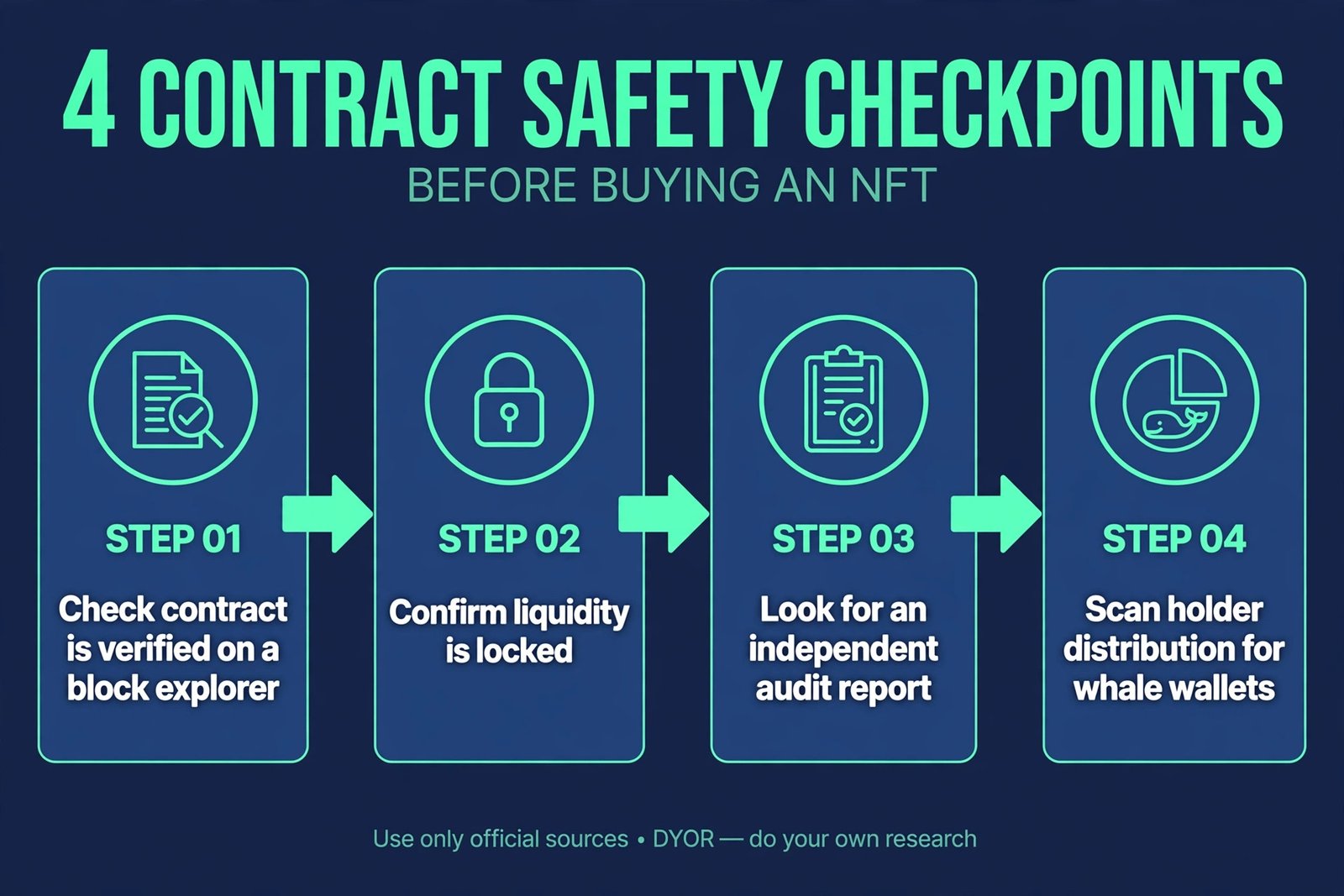
Checkpoint 3: Does the contract itself block you from selling?
Some scams do not even need the team to disappear. A honeypot contract lets you buy but silently blocks selling, sometimes through a function that activates after launch. Others let developers mint unlimited tokens or change the rules mid-game through admin privileges. You do not need to read code to protect yourself: check whether the contract has a real audit from a known security firm (and verify the audit on the firm’s own site, because fake audit badges are a 2026 staple), and search the contract address in scam databases before you interact with it. Never sign a transaction you do not understand, and never connect your main wallet to a mint site you have not vetted. Use a separate wallet with limited funds for anything experimental.
Warning: the most dangerous moment is the signature request. A malicious approval can drain your wallet in one click. If a mint site asks for an unusual permission, close the tab and research the project again from scratch.
Checkpoint 4: Is the hype real?
Rug pulls run on manufactured urgency: countdown timers, “whitelist-only” access, influencer posts that all appear on the same day, and promises of guaranteed returns. Real projects do not need to pressure you, because the opportunity will still exist tomorrow after you have done your research. Be especially skeptical of guaranteed profit claims. No legitimate crypto project can promise returns, and anyone who does is either lying or clueless. Paid promotions are common even in honest projects, so the question is not whether marketing exists, but whether anything substantive sits underneath it.
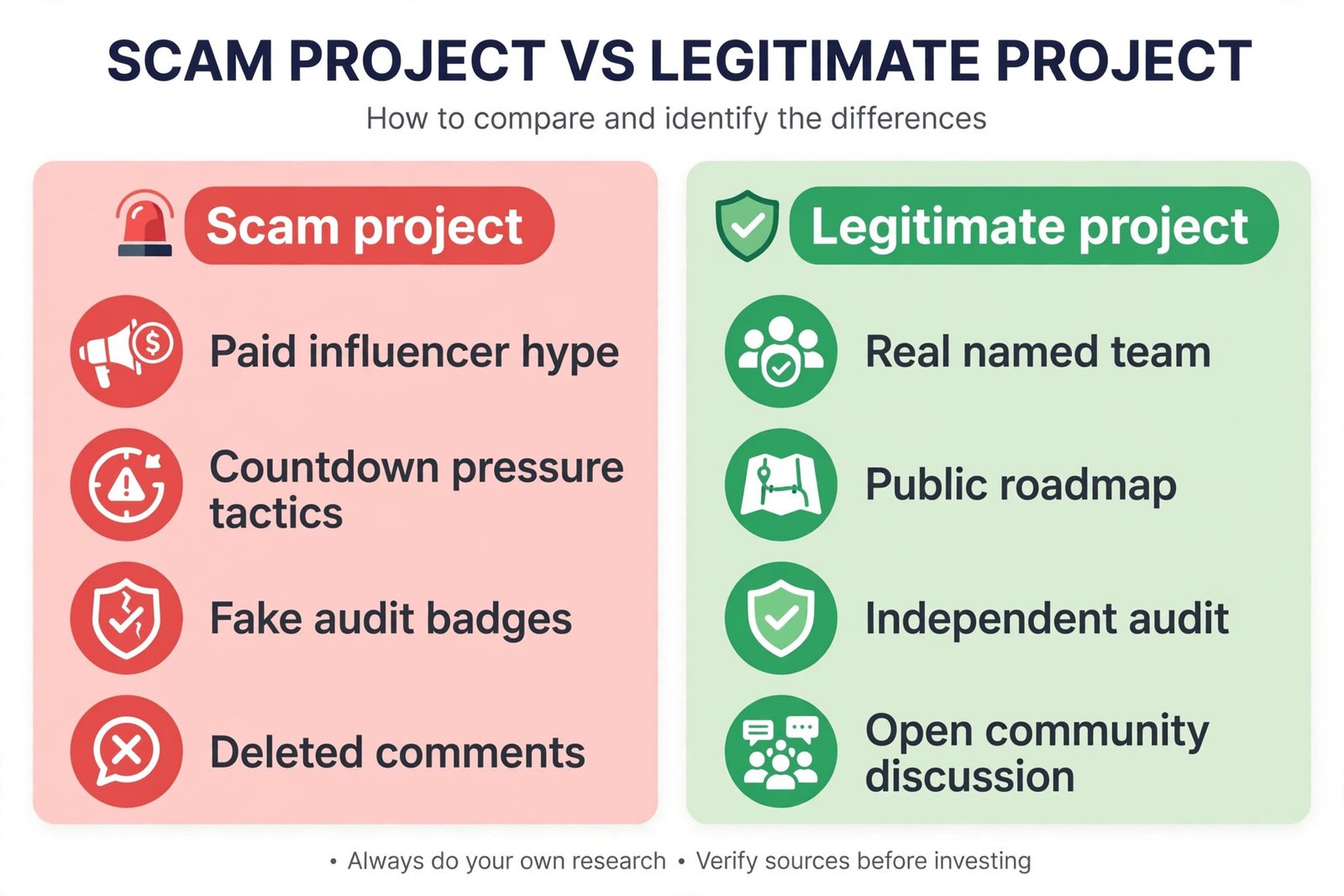
Hype-driven crypto is not limited to NFTs. The same pressure tactics show up in move-to-earn tokens and play-to-earn games, where “free money” framing does most of the scammer’s work for them.
If you already bought into a likely rug pull
- Stop putting money in. Do not “average down” on a project that is showing scam signs.
- Revoke token approvals you granted to the project’s contracts, so a malicious contract cannot move your other tokens later.
- Document everything: the site URL, contract address, team claims, and your transactions. Screenshots help.
- Report it. In the US, you can report crypto fraud to the FTC at reportfraud.ftc.gov. Reports help investigators connect cases, even if recovery is unlikely.
- Warn others in the project’s community channels with evidence, not just accusations. Then leave those channels; scammers often run a second scam targeting earlier victims.
What this guide is not
This is a safety checklist, not financial advice. It will not tell you which NFTs to buy, and passing these checks does not make a project a good investment. Even honest projects fail, and NFT prices are volatile by nature. Treat every purchase as money you are prepared to lose completely, because in the worst case, that is exactly what happens.
Frequently asked questions
Are NFT rug pulls still common in 2026?
Yes. Enforcement has improved and some promoters have faced charges, but the basic scam still works because it exploits hype and urgency rather than technology. New variants like slow rugs, where the team sells gradually over weeks, are harder to spot than the old sudden disappearances.
Does a contract audit mean a project is safe?
No. An audit from a reputable firm reduces certain technical risks, but it does not prevent the team from abandoning the project, and fake audit badges are common. Treat an audit as one positive signal among many, and always verify it on the auditor’s own website.
Can I get my money back after a rug pull?
Usually not. Crypto transactions are irreversible, and scam teams are hard to identify, let alone sue. Reporting helps authorities build cases, and a few high-profile prosecutions have happened, but you should assume lost funds are gone and focus on not repeating the mistake.

- How to Avoid Black Friday Scams in 2026: The Scam-Spotting Field Guide - October 15, 2026
- Best Mini Projectors for Movie Nights in 2026 (Under $100) - October 15, 2026
- 5 Best Smart Plugs for Holiday Lights in 2026 (Automate Christmas) - October 15, 2026