
Your ecommerce platform decides what every sale costs you, how fast your store loads, and whether a 2 AM checkout bug is your problem or someone else’s. Pick wrong and you pay in migration pain later, because moving a live store with real orders is the one project every merchant regrets. This guide compares the 7 ecommerce platforms worth considering in 2026, ordered by how well they fit different businesses, with current pricing from each vendor so you can match the tool to your business instead of the other way around.
Why This Choice Matters More Than Your Theme
A theme can be changed in an afternoon; a platform migration takes weeks and risks your search rankings, customer accounts, and order history. The platform also sets your fee structure on every single transaction for years, so a 2 percent difference on a store doing $10,000 a month is $200 a month, forever. That is why this guide weighs pricing, transaction fees, and who handles the technical work, not just feature checklists.
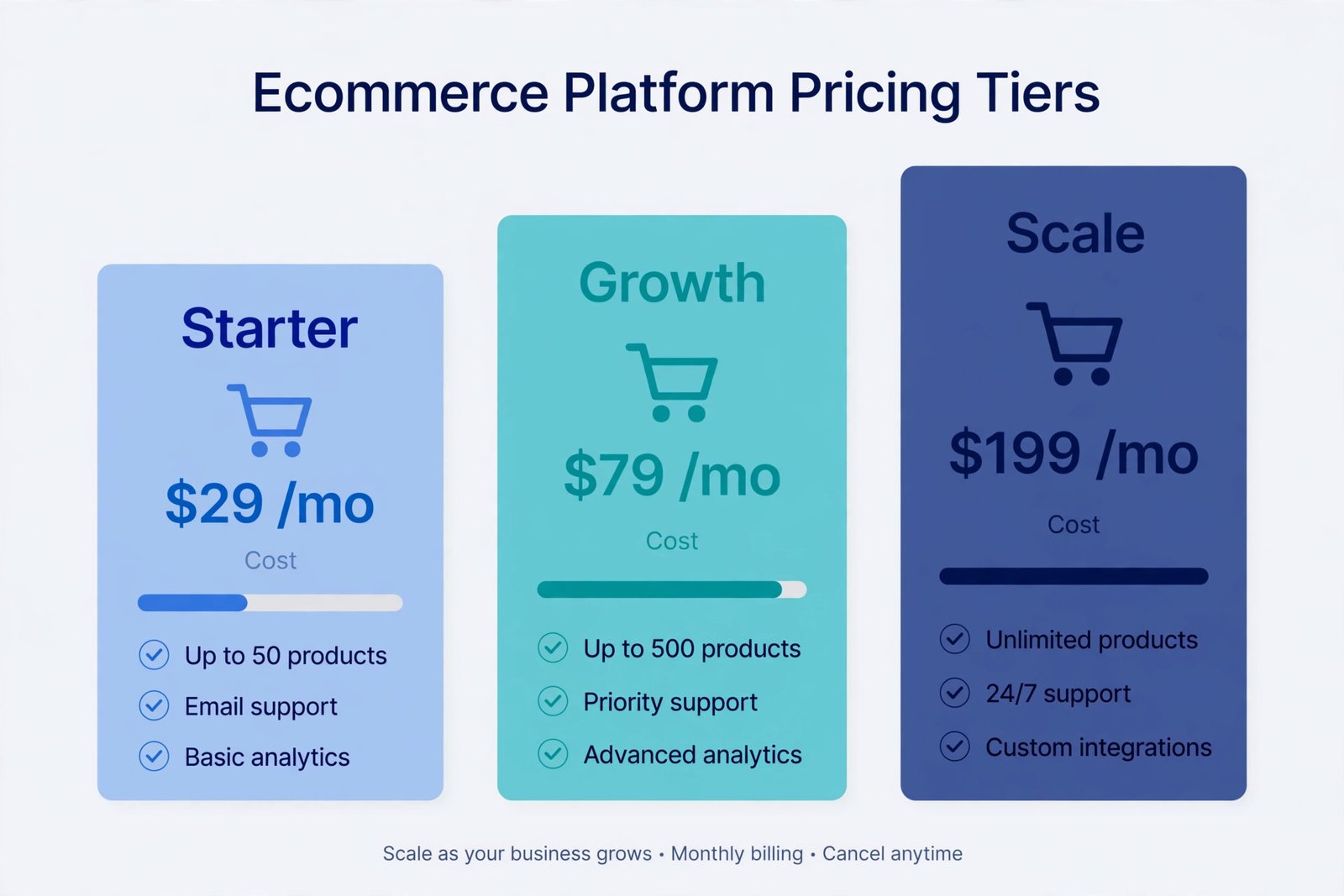
Shopify: Best for Beginners and Fast-Growing Brands
Shopify remains the default recommendation for most new stores because it removes the most work: hosting, security, PCI compliance, and updates are all handled, and you get a polished store on day one. The app marketplace, now 13,000-plus apps strong, covers everything from subscriptions to print-on-demand.
Pricing in 2026: Basic is $39 per month billed monthly or $29 billed annually, with Grow at $105 and Advanced at $399. Transaction fees are 0 percent with Shopify Payments but 0.6-2 percent with a third-party gateway. The SEO trade-off is real: fixed URL prefixes like /products/ and /collections/ limit how much you can tune, so content-heavy brands should read the WooCommerce section before deciding. Check our free SEO tools guide to see what optimization looks like once the store is live.
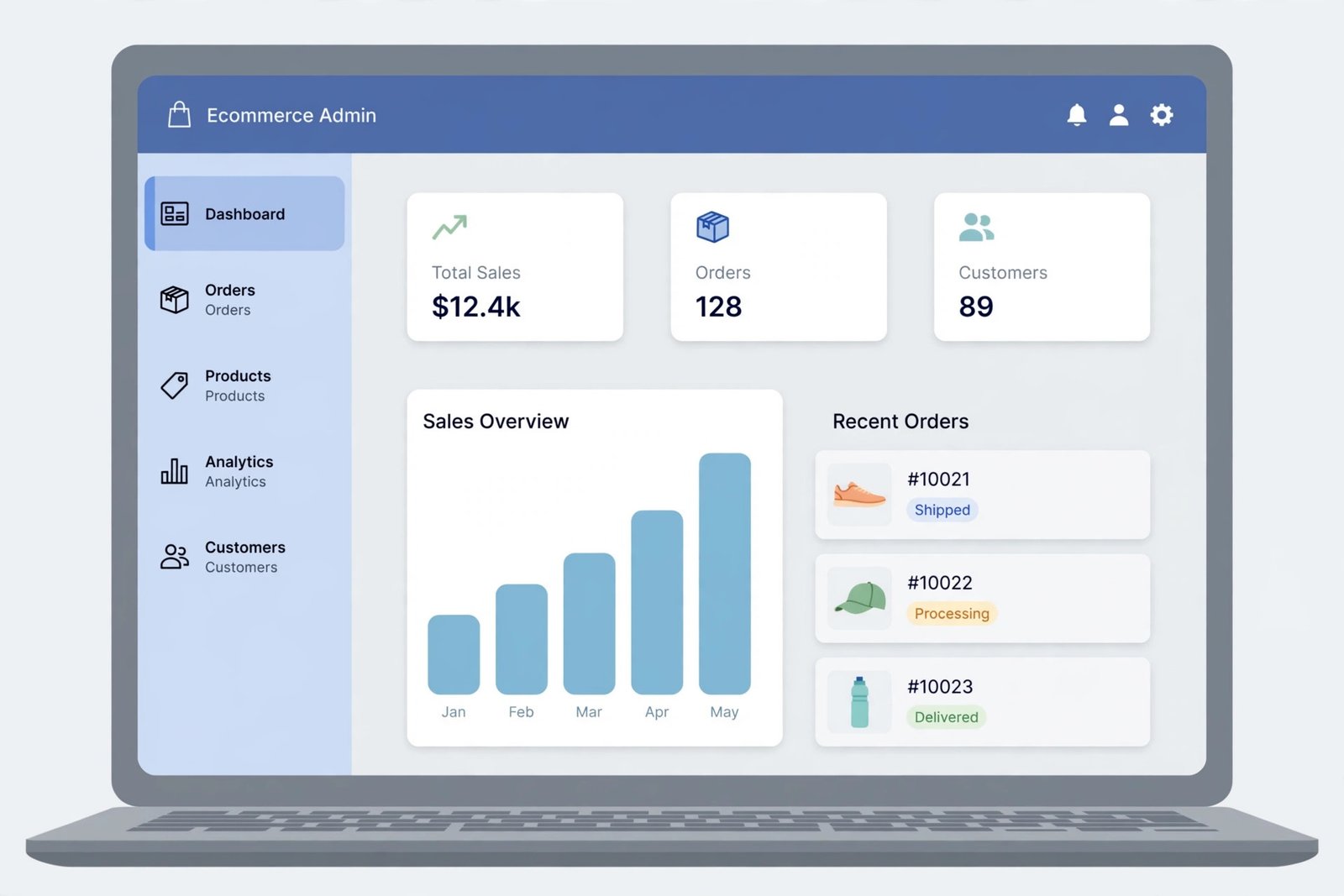
WooCommerce: Best for WordPress Users and Content-First Stores
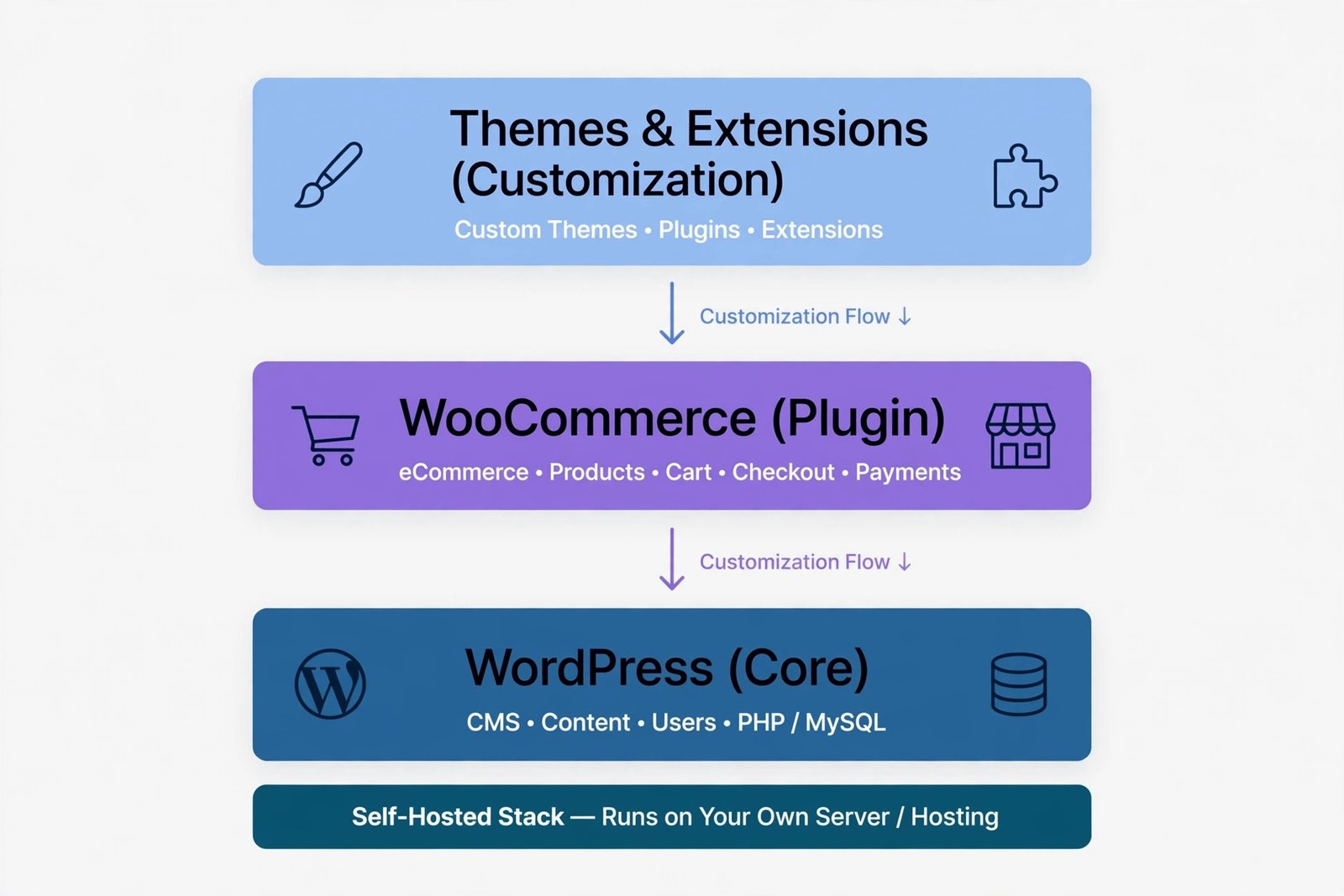
WooCommerce is a free WordPress plugin that turns a WordPress site into a full store, and it wins on two things nobody else matches: total customization and content. If your business runs on blog traffic, reviews, and organic search, nothing beats the WordPress publishing engine paired with full URL control and plugins like Yoast or RankMath.
Pricing in 2026: the plugin itself is free; you pay for hosting ($10-100-plus per month depending on traffic) and any premium extensions. There are no platform transaction fees, only your payment gateway’s. The trade-off is that you own everything: hosting, updates, security, backups, and PCI. If that sounds like a lot, our guide on how to change web hosting explains what owning the stack actually involves.
BigCommerce: Best for Mid-Market and B2B Sellers
BigCommerce sits between Shopify’s simplicity and WooCommerce’s openness: fully managed hosting like Shopify, but with more ecommerce features built in natively, so you buy fewer apps. It is the strongest pick for stores scaling internationally, with multi-currency selling and B2B quoting tools that would cost extra elsewhere.
Pricing in 2026: Standard is $39 per month billed monthly or $29 billed annually, with Plus at $105 and Pro at $399. One change to know: since June 2026, non-embedded payment gateways carry a 0.6-2 percent Open Payment Provider fee, and plans auto-upgrade based on trailing-12-month sales volume, so fast growers should model the upgrade path, not just the entry price.
Wix eCommerce: Best for Simple Stores on a Builder
Wix is for the solopreneur who wants a website and a small store from one drag-and-drop builder, with strong templates and a decent app market. It handles the basics well: product pages, payments, and built-in marketing tools.
Pricing in 2026: ecommerce plans run about $27-29 per month. The ceiling arrives fast, though: customization is limited, and stores that outgrow the builder face the same migration pain this guide warns about. Great for a first 50 products; plan an exit strategy before product 500. Non-technical founders should also skim our guide to low-code platforms for what “no-code” can and cannot do at scale.
Squarespace Commerce: Best for Design-Led Brands
Squarespace wins on looks: its templates are the best in this price class, and blogging tools are built in for brands that sell through storytelling. For a small catalog where design is the differentiator, it is the fastest path to a store you are proud to link.
Pricing in 2026: commerce plans start around $25-27 per month. Like Wix, it is not built for large catalogs or complex shipping rules, and the app ecosystem is smaller than Shopify’s or WooCommerce’s. Choose it when the brand is the product as much as the products are.
Ecwid: Best for Adding a Store to an Existing Site
Ecwid (now part of Lightspeed) takes a different approach: instead of a new site, it drops a store widget into your existing website, blog, or even social pages. For creators and bloggers who need “buy” buttons without rebuilding anything, it is the path of least resistance.
Pricing in 2026: starts from $19 per month, with a limited free plan for tiny catalogs. It is not a full CMS replacement, so do not choose it to build a brand home from scratch; choose it when the site already exists and the store is the add-on.
Adobe Commerce: Best for Enterprise Complexity
When does Adobe Commerce make sense?
Adobe Commerce (the enterprise evolution of Magento) is for large businesses with complex catalogs, multi-store setups, and heavy B2B requirements that need full control of the code and hosting. It is the only platform on this list that assumes you have developers.
Pricing in 2026: starts around $2,000-plus per month, with custom enterprise quotes. If that number does not make you flinch, you are its audience; if it does, one of the six options above will serve you better and faster.
Side-by-Side: 2026 Pricing at a Glance
| Platform | Starting price (2026) | Hosting | Best for |
|---|---|---|---|
| Shopify | $29/mo billed annually ($39 monthly) | Included | Beginners, fast-growing DTC brands |
| WooCommerce | Free plugin + $10-100+/mo hosting | Self-managed | WordPress users, content-driven stores |
| BigCommerce | $29/mo billed annually ($39 monthly) | Included | Mid-market, B2B, international sellers |
| Wix eCommerce | ~$27-29/mo | Included | Small stores on a simple builder |
| Squarespace Commerce | ~$25-27/mo | Included | Design-led brands, creators |
| Ecwid | From $19/mo (free plan available) | N/A (embeds in your site) | Adding a store to an existing site |
| Adobe Commerce | $2,000+/mo | Self or Adobe Cloud | Enterprise, complex B2B |
The Verdict
For most new stores, Shopify is the right call: the least technical work, the biggest app ecosystem, and pricing that scales predictably. If your business is built on content and organic search, WooCommerce repays the extra technical ownership with unmatched SEO control. If you are scaling toward mid-market or B2B, BigCommerce gives you managed hosting with stronger native features than Shopify. Pick Wix or Squarespace for small, beautiful stores you can launch this week, Ecwid when the site already exists, and Adobe Commerce only when enterprise complexity demands it. Whichever you choose, decide for where your revenue will be in two years, because the cheapest platform today is rarely the cheapest platform after a migration.

- How to Change the Screenshot Save Location on Mac - October 24, 2026
- How to Turn Off Stage Manager on Mac - October 23, 2026
- How to Reset Your Private Space PIN on Android If You Forgot It - October 22, 2026