
Every object around you was made somehow, yet the methods behind them are rarely explained in plain language. Students hit this wall in coursework, buyers hit it when comparing products, and curious makers hit it when an idea needs to become a thing. The fix is simpler than it looks: nearly all manufacturing falls into five families of processes. Learn those five, and you can reason about how almost anything was made.
What Is a Manufacturing Process?
A manufacturing process is any method that converts raw material into a finished product by changing its shape, its properties, or both. The word comes from the Latin manu factus, made by hand, though today most of it is done by machines.
Practical examples make the definition concrete. Pouring molten aluminum into a mold to form an engine block is a manufacturing process. Milling a phone chassis out of a solid block of metal is a different manufacturing process. Printing a replacement gear layer by layer on a 3D printer is a third. Same goal, a finished part, reached by completely different routes, each with its own costs, strengths, and limits.
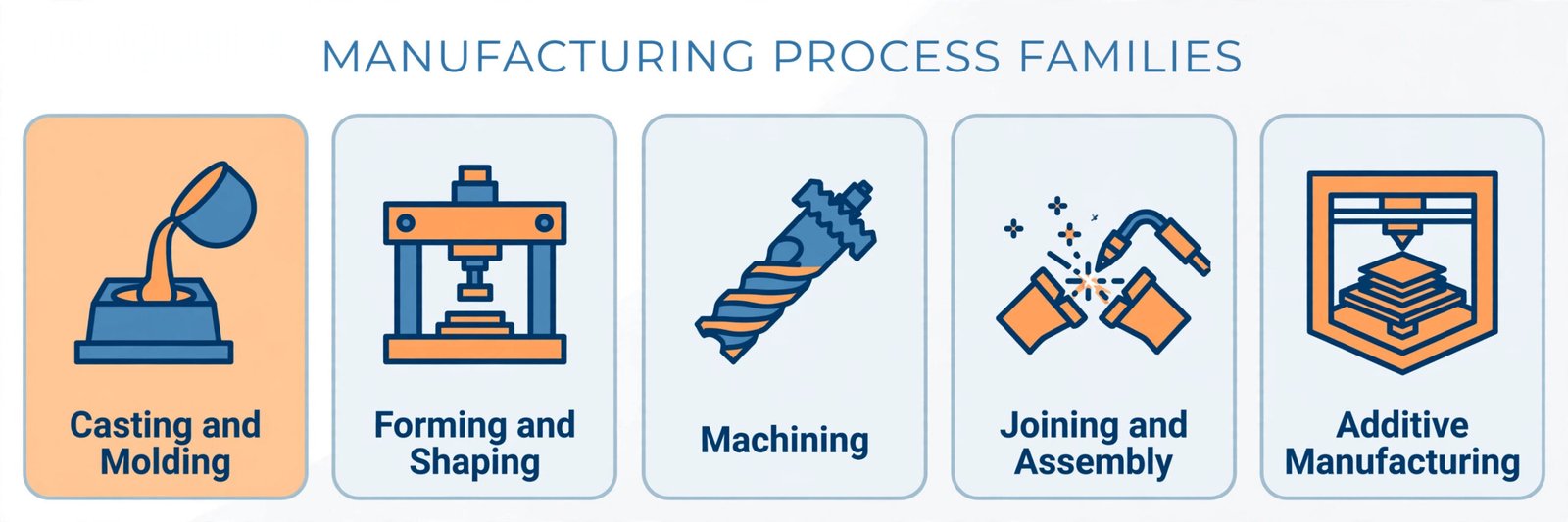
The Five Main Families of Manufacturing Processes
Casting and Molding
Liquid or softened material is poured or injected into a mold and left to solidify into shape. Sand casting makes engine blocks and heavy machinery parts; die casting produces precise metal components like gearbox housings; injection molding turns plastic pellets into phone cases, bottle caps, and Lego-style bricks by the million.
The strength of casting and molding is volume: once the mold exists, each additional part is cheap. The weakness is the mold itself, which is expensive to make and hard to change, so this family suits designs that are settled and needed in quantity.
Forming and Shaping
Material is deformed into shape by mechanical force, with or without heat. Forging hammers or presses steel into crankshafts and wrenches that must survive brutal stress. Rolling flattens metal into sheets for car body panels. Extrusion pushes material through a shaped die to make window frames, pipes, and rails in continuous lengths.
Forming keeps the material’s internal grain structure intact or even improves it, which is why forged parts are famously strong. The trade-off is limited geometric freedom: you cannot form the intricate internal shapes that other families allow.
Machining
Material is cut away from a solid block until the desired shape remains. Milling carves with a rotating cutter, turning spins the workpiece against a fixed tool to make shafts and bolts, and drilling, grinding, and planing handle holes and fine finishes. Most of it today is CNC machining, where a computer guides the tools.
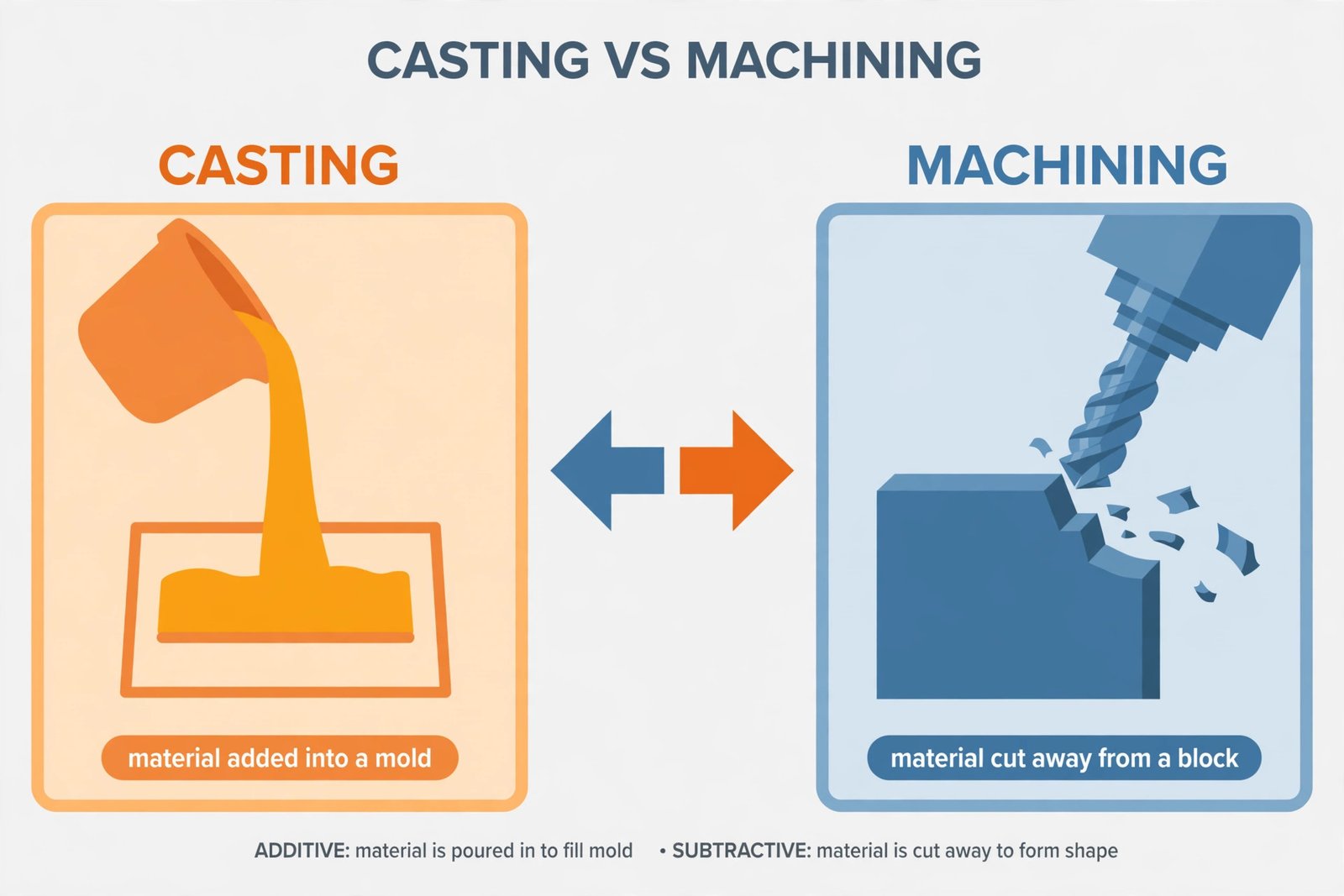
Machining offers superb precision with no expensive mold, which makes it ideal for prototypes and low volumes. The catch is waste and time: cutting a part out of a block discards material and takes far longer per piece than molding it, so it is slow for mass production.
Joining and Assembly
Separate components are united into a larger whole. Welding fuses metal parts into bicycle frames and ship hulls. Brazing and soldering join with a lower-melting filler metal, the latter being how every circuit board connects its components. Adhesive bonding glues composites in aircraft, and mechanical fasteners, bolts, rivets, and screws, hold together everything from furniture to engines. If you want the engineering view of how these compare, Wevolver’s metal process comparison lays out the trade-offs in detail.
Joining is what turns individual parts into products. Its challenge is the joint itself: a weld or glue line is often the weakest point, so joint design and inspection matter as much as the joining method.
Additive Manufacturing (3D Printing)
Objects are built layer by layer from plastic, resin, or metal powder, following a digital model. A hobbyist prints a replacement dishwasher clip at home; a hospital prints a patient-specific bone plate; an aerospace shop prints fuel nozzles with internal channels no other method can produce.
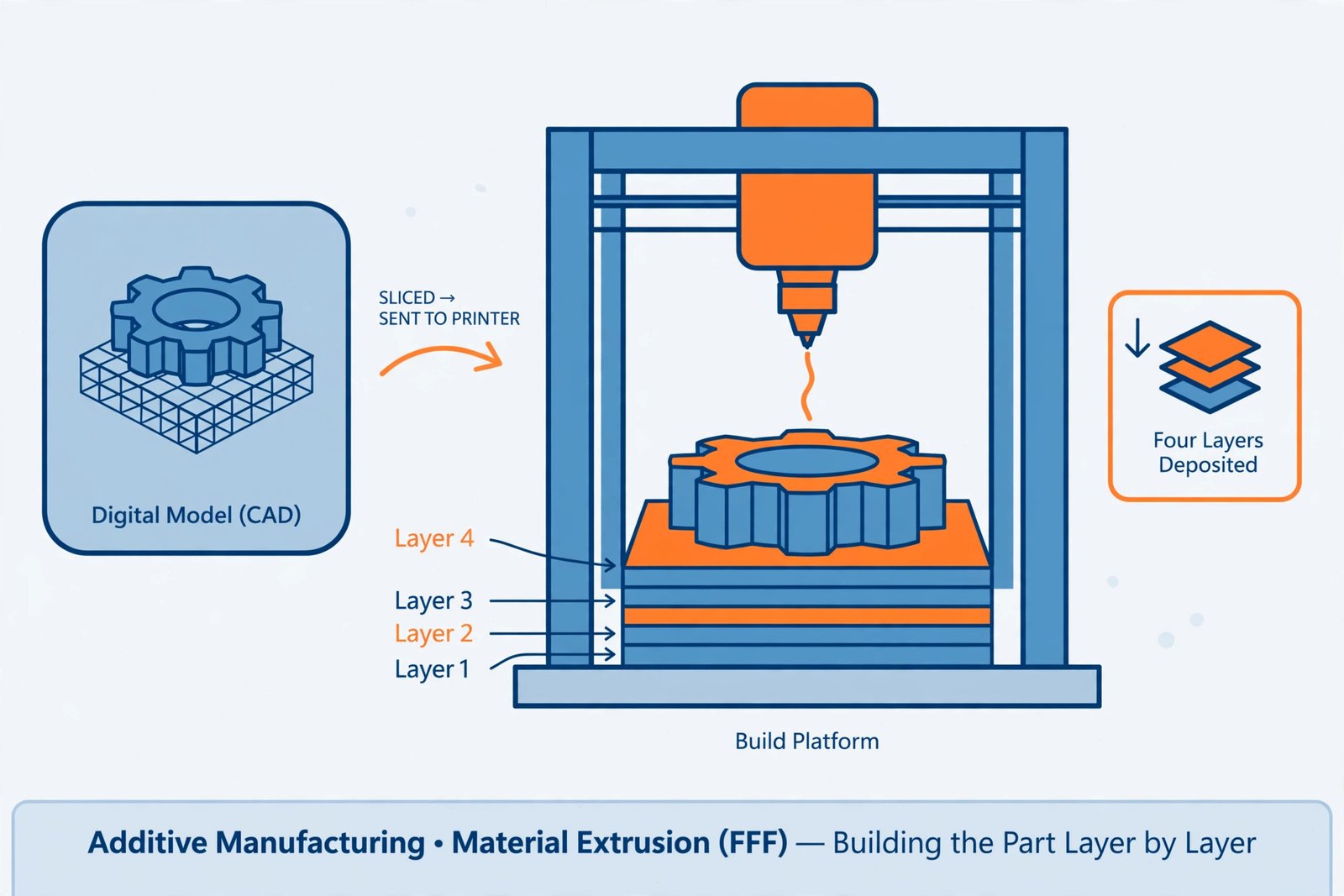
Additive offers unmatched geometric freedom with zero tooling, which is why it dominates prototyping and custom parts. Its limits are speed and strength: printing thousands of identical parts is slow, and printed parts are often weaker than forged or machined equivalents. The latest gadgets you read about, like the ones in our trending gadgets roundup, often start life as 3D-printed prototypes before moving to molded production.
How These Processes Differ: Side-by-Side
| Family | How it works | Best for | Main limitation |
|---|---|---|---|
| Casting and molding | Liquid material solidifies in a mold | High-volume identical parts | Expensive molds, hard to change |
| Forming and shaping | Force deforms solid material | Strong parts in steady volumes | Limited geometric freedom |
| Machining | Material cut away from a block | Precise, low-volume parts | Slow and wasteful at scale |
| Joining and assembly | Parts united into products | Building complex products | Joints can be weak points |
| Additive manufacturing | Built layer by layer | Prototypes and complex custom parts | Slow for mass production |
How to Choose the Right Process
Process selection comes down to four questions. How many do you need? Ten units points to machining or 3D printing; ten million points to molding or casting. How complex is the shape? Internal channels and lattices favor additive; simple strong shapes favor forming. What material? Each process suits certain materials, and the wrong pairing fails expensively. What precision and finish are required? Machining wins on tolerances, molding on smooth as-made surfaces.
Real products often mix families: a power drill has an injection-molded housing, machined metal gears, a formed steel chuck, and soldered electronics, all joined on an assembly line. Hybrid approaches, like printing a near-final shape and then machining it to tolerance, are a growing trend.
Verdict: Start With the Product, Not the Process
If you remember one thing, make it this: the product’s needs choose the process, never the other way around. Volume, complexity, material, and precision narrow the field to one or two families almost every time. Casting and molding rule mass production, forming rules strength, machining rules precision, joining rules assembly, and additive rules complexity and customization. With those five families in your head, you can look at any manufactured object and make a good guess at how it came to be.

- How to Reset Your Private Space PIN on Android If You Forgot It - October 22, 2026
- How to Turn Off Hot Corners on a Mac - October 21, 2026
- How to Stop AirPods From Automatically Switching Between iPhone and Mac - October 20, 2026