Fix: Unable to Set Printer as Default in Windows 10/11

You want to set a printer as default in Windows 10 or 11, but the option won’t stick. You click the button, it seems to work, then defaults back to another printer. Or the option is greyed out entirely. This is frustrating because Windows should handle this in seconds.

The good news: This usually has a simple fix. Most issues come from outdated drivers, permission problems, or Windows settings conflicts. Let’s walk through real solutions that work.

Why This Happens

Windows sometimes struggles with printer defaults for a few reasons:

Outdated printer drivers are the most common culprit. If your driver hasn’t been updated in months or years, it can’t communicate properly with Windows.

Permission issues prevent you from changing settings. Your user account might not have admin rights to modify printer settings.

Print spooler service problems occur when the background service managing your printers crashes or stops running.

Multiple printer instances confuse Windows. You might have the same printer listed twice with different names.

Windows updates occasionally reset printer settings or introduce temporary bugs.

Third-party software conflicts can interfere. Security software or printer manufacturer apps sometimes block changes.

Understanding the cause helps you pick the right fix. Let’s start with the fastest solutions first.

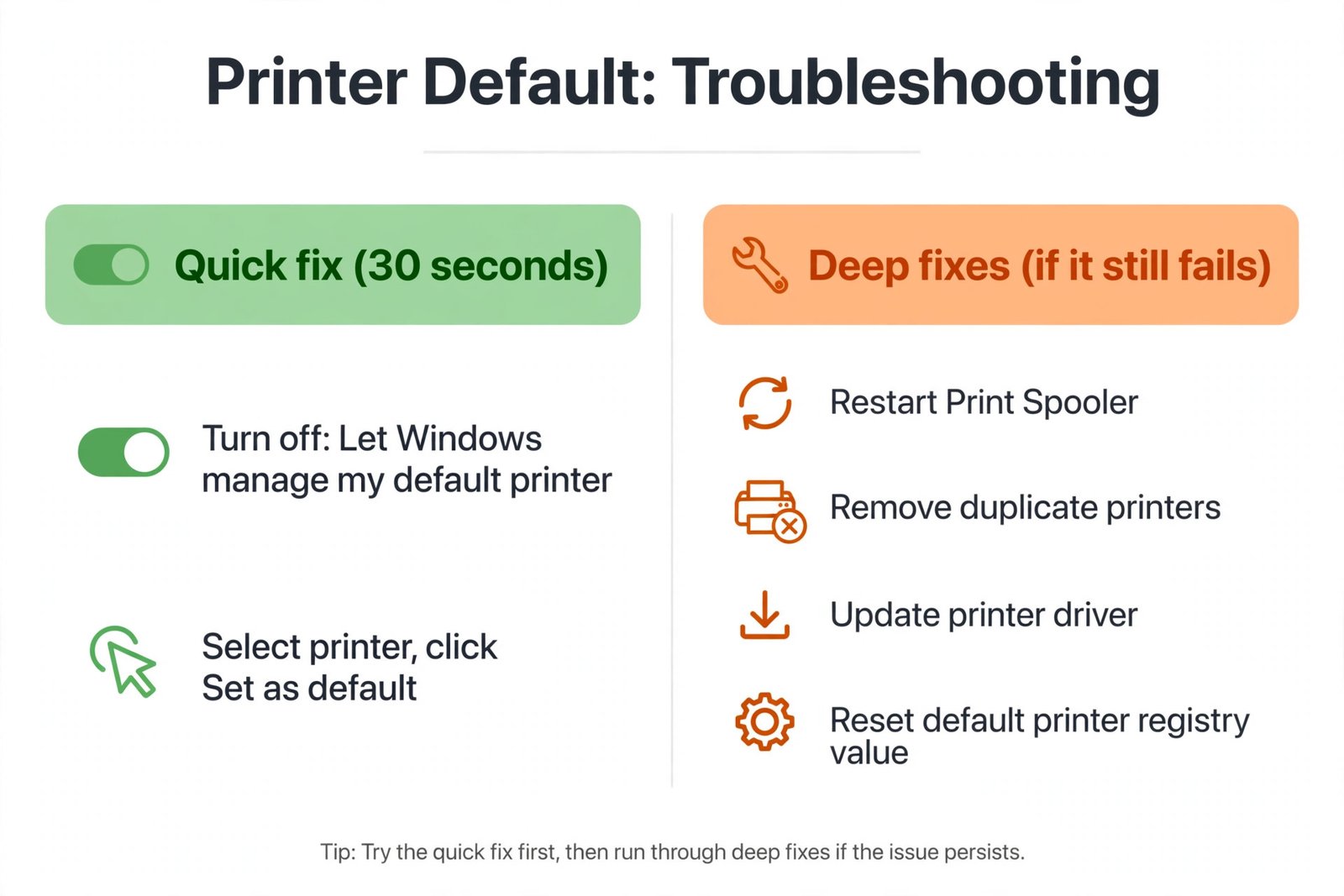
Quick Fixes (Try These First)

Restart the Print Spooler Service

The print spooler is a Windows service that manages all printer communication. Restarting it often fixes default printer problems instantly.

For Windows 10 and 11:

  1. Press Windows key + R together
  2. Type services.msc and press Enter
  3. Scroll down to “Print Spooler”
  4. Right-click it and select “Restart”
  5. Wait 10 seconds for it to fully restart

This simple step resolves about 30% of printer default issues. If your printer works after this, you’re done.

Remove and Re-Add Your Printer

Sometimes Windows corrupts the printer entry. Removing it completely and adding it fresh often works.

Step by step:

  1. Open Settings (Windows key + I)
  2. Go to Devices > Printers & Scanners
  3. Find your printer in the list
  4. Click it and select “Remove device”
  5. Wait 30 seconds
  6. Click “Add a printer or scanner”
  7. Select your printer from the list
  8. Complete the setup wizard
  9. Right-click the printer and set as default

This resets the printer configuration to factory settings within Windows. No data is lost. Your printer choice will likely stick this time.

Check Admin Rights

You need administrator privileges to change default printers in Windows.

Verify your permissions:

  1. Open Settings
  2. Go to Accounts > Your info
  3. Look for “Administrator” or “Standard user”
  4. If you see “Standard user,” ask your system administrator to upgrade your account

If this is your personal computer and you’re the owner, you should be an administrator. Contact whoever set up your computer if you’re unsure.

Deeper Fixes (If Quick Fixes Didn’t Work)

Update Your Printer Drivers

Outdated drivers cause most Windows 10 and 11 printer problems.

Method 1: Automatic driver update

  1. Open Settings > Devices > Printers & Scanners
  2. Right-click your printer
  3. Select “Update driver”
  4. Choose “Search automatically for updated driver software”
  5. Wait for Windows to search and install any available updates
  6. Restart your computer
  7. Try setting the printer as default again
See also  Best Windows Live Mail Alternatives: A Practical Guide to Finding Your Next Email Client

Method 2: Manufacturer website

This often works better than automatic updates.

  1. Identify your printer model (check the physical printer or Settings)
  2. Visit the manufacturer’s support website (HP, Canon, Brother, Epson, etc.)
  3. Search for your specific printer model
  4. Download the latest driver for Windows 10 or 11 (64-bit or 32-bit, depending on your system)
  5. Run the installer and follow instructions
  6. Restart your computer
  7. Set printer as default

Finding your Windows version:

Right-click “This PC” or “My Computer” > Properties. Look for “System type” to see if you have 64-bit or 32-bit Windows.

Most modern computers are 64-bit. Check before downloading drivers.

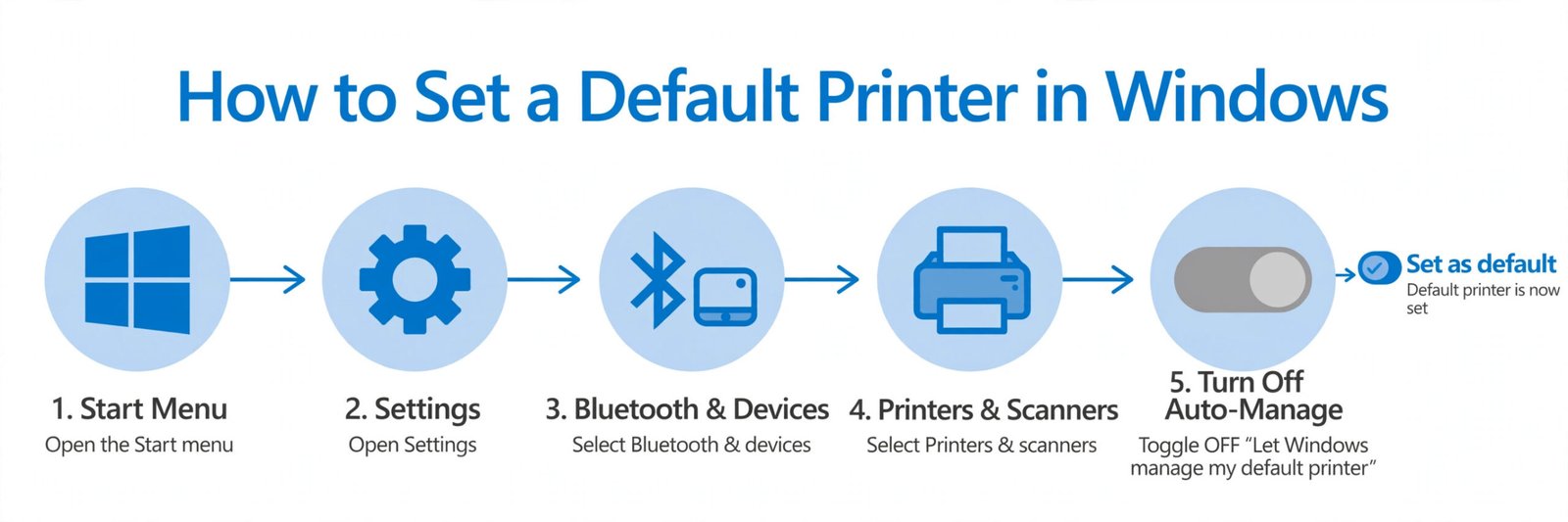
Disable “Let Windows Manage My Default Printer”

Windows 10 and 11 have an automatic printer selection feature that sometimes overrides your choice.

Turn it off:

  1. Go to Settings > Devices > Printers & Scanners
  2. Scroll to the bottom of the page
  3. Find “Let Windows manage my default printer”
  4. Toggle this setting OFF
  5. Now set your printer as default manually

This setting lets Windows automatically change your default printer when you connect a new one. For most people, this is annoying. Turning it off gives you full control.

Clear the Print Spooler Queue

If documents are stuck in the queue, they can prevent printer changes from working.

Clear stuck print jobs:

  1. Press Windows key + R
  2. Type: %systemroot%\System32\spool\PRINTERS
  3. Press Enter
  4. A folder will open with print jobs
  5. Select all files in this folder (Ctrl + A)
  6. Delete them (press Delete)
  7. Close the folder
  8. Restart your computer

Don’t worry if some files are in use. Windows will skip those and delete the rest. This cleans out corrupted or stuck print jobs.

Check for Multiple Printer Entries

Windows sometimes lists the same printer twice. This confuses the system.

Find and remove duplicates:

  1. Open Settings > Devices > Printers & Scanners
  2. Look at your full printer list
  3. If you see the same printer listed twice (even with slightly different names), remove one
  4. Right-click the duplicate and select “Remove device”
  5. Restart your computer
  6. Set the remaining printer as default

Look for printers with names like:

  • “HP LaserJet Pro” and “HP LaserJet Pro (Copy 1)”
  • “Canon MF445dw” and “Canon MF445dw – Network”
  • Generic names like “Print Queue” mixed with the real name

Only keep one entry per physical printer.

Advanced Fixes (For Persistent Issues)

Reset Print Settings via Registry

For advanced users comfortable with the Windows Registry.

Important: Back up your registry first.

  1. Press Windows key + R
  2. Type: regedit
  3. Press Enter
  4. Navigate to: HKEY_CURRENT_USER\Software\Microsoft\Windows NT\CurrentVersion\Devices
  5. Look for entries related to your printer
  6. Right-click suspicious entries and delete them
  7. Restart your computer
  8. Add your printer again through Settings

The Registry is powerful but also risky. Only do this if you’re comfortable editing system files. One mistake could cause problems.

Uninstall and Reinstall Printer Software

Complete removal of printer software and drivers.

Full removal:

  1. Go to Settings > Apps > Apps & features
  2. Search for your printer brand name (HP, Canon, Brother, etc.)
  3. Click the printer software and select “Uninstall”
  4. Follow the uninstall wizard completely
  5. Restart your computer (important)
  6. Download fresh drivers from the manufacturer’s website
  7. Install the new drivers
  8. Restart again
  9. Set as default
See also  Fix "Processing of Group Policy Failed" Error in Windows: Complete Guide

This nuclear option works when everything else fails. It takes longer but provides a completely fresh start.

Run Printer Troubleshooter

Windows has a built-in printer troubleshooter.

Access it:

  1. Open Settings > System > Troubleshoot
  2. Click “Other troubleshooters”
  3. Find “Printer” in the list
  4. Click “Run” next to it
  5. Let Windows scan for problems
  6. Apply any recommended fixes
  7. Restart and test

Windows will detect common printer problems and fix them automatically. This often works for stubborn cases.

Preventing Future Problems

Once you fix this issue, keep it fixed with simple maintenance.

Monthly:

  • Check for driver updates from your printer manufacturer
  • Restart your computer (actually helps printer stability)

Quarterly:

  • Update Windows (Settings > Update & Security)
  • Check for accumulated print jobs and clear them

When adding new printers:

  • Download the latest drivers before connecting the new printer
  • Don’t let Windows install generic drivers first
  • Restart after installation completes
  • Only then set as default

For network printers:

  • Write down the printer’s IP address
  • Check that the printer and computer are on the same network
  • Restart the printer monthly (turn off for 30 seconds, turn back on)

These habits prevent most printer problems from starting.

Fix Methods

Fix MethodTime RequiredSuccess RateTechnical DifficultyBest For
Restart Print Spooler2 minutes30%Very EasyQuick diagnosis
Remove and Re-add5 minutes40%EasyFresh start needed
Update Drivers10 minutes60%EasyOutdated software
Disable Auto-manage1 minute20%EasyInterference from Windows
Clear Print Queue5 minutes35%MediumStuck print jobs
Registry Edit15 minutes70%HardNothing else works
Full Reinstall30 minutes85%MediumSevere corruption
Run Troubleshooter10 minutes45%EasyAutomated help

What to try first: Start with quick fixes at the top. If those don’t work, move down the list. Most people succeed with one of the first three methods.

Troubleshooting by Situation

The printer won’t stay default after restart

Likely cause: Windows auto-manage setting or corrupted driver

Try first: Disable “Let Windows manage my default printer” setting (see earlier steps)

Then: Update drivers from manufacturer website

Setting as default is greyed out

Likely cause: You lack admin rights or the printer is offline

Try first: Check that you’re logged in as administrator

Then: Power cycle the printer (turn off, wait 30 seconds, turn on)

Finally: Remove and re-add the printer

Computer won’t recognize my printer at all

Likely cause: Missing drivers or USB connection issue

Try first: Restart the computer with the printer connected

Then: Download drivers from the manufacturer before the printer is detected

Finally: Try a different USB port or USB cable

Printer shows as offline but it’s actually on

Likely cause: Network connectivity or driver issue

Try first: Restart both the computer and printer

Then: Check that the printer is on the same WiFi network (for wireless printers)

Finally: Update the printer’s firmware from its control panel

One user account can’t set default, but another can

Likely cause: Permission problem on that user account

Try first: Log in as administrator and set it for the limited account

See also  Best Free Alternatives to Windows Operating Systems: Complete Guide for Switching Today

Then: Check that user account permissions in Settings > Accounts

Common Questions (FAQs)

How do I know if I have admin rights?

Open Settings > Accounts > Your info. If it says “Administrator” next to your account name, you have admin rights. If it says “Standard user,” you don’t. Ask whoever manages your computer to upgrade you.

Will removing my printer delete my documents?

No. Removing a printer from Windows only removes the printer entry. Your documents stay on your computer. Print jobs will be deleted, but those are just temporary files waiting to print. Your saved documents are safe.

Why does Windows change my default printer when I connect a new one?

That “Let Windows manage my default printer” feature is designed to help but usually annoys people. It automatically sets newly connected printers as default. Turn this off in Settings > Devices > Printers & Scanners if you prefer choosing manually.

Can I have multiple default printers?

No. Windows allows only one default printer at a time. If you regularly switch between two printers, just right-click the one you want and select “Set as default” when needed. It’s a two-second process.

What if my printer is brand new and still won’t work as default?

New printers often ship with outdated drivers. Visit the manufacturer’s website (before or after connecting the printer) and download the latest drivers for your specific model and Windows version. Install these fresh drivers before trying to set it as default. This solves nearly all new printer problems.

Summary

Unable to set printer as default problems are frustrating but fixable. Most issues come from outdated drivers, Windows settings conflicts, or printer service problems.

Start here:

  1. Restart the print spooler service (2 minutes, 30% success)
  2. Remove and re-add your printer (5 minutes, 40% success)
  3. Update drivers from the manufacturer (10 minutes, 60% success)
  4. Disable Windows auto-manage setting (1 minute, 20% success)

If those don’t work, try clearing the print queue or running the Windows troubleshooter. For stubborn cases, a full reinstall of printer software works 85% of the time.

Most people solve this in under 10 minutes. You likely will too.

Conclusion

Your printer should work smoothly. These fixes address every common reason why you can’t set a default printer in Windows 10 and 11. Follow the steps in order, and you’ll regain control of your printer settings.

The print spooler restart and driver update fix the vast majority of cases. Start there. If you’re still stuck after trying these methods, the problem is rare enough that contacting your printer manufacturer’s support team directly makes sense. They can access your system specifically and identify the exact issue.

Until then, you now understand what causes these problems and how to fix them. Keep your drivers updated going forward, and you likely won’t face this issue again.

Helpful Resources:
For driver downloads, visit HP Support, Canon, Brother, Epson, or Xerox directly. Manufacturer support pages are the most reliable source for current drivers.

Osmanim
Scroll to Top