
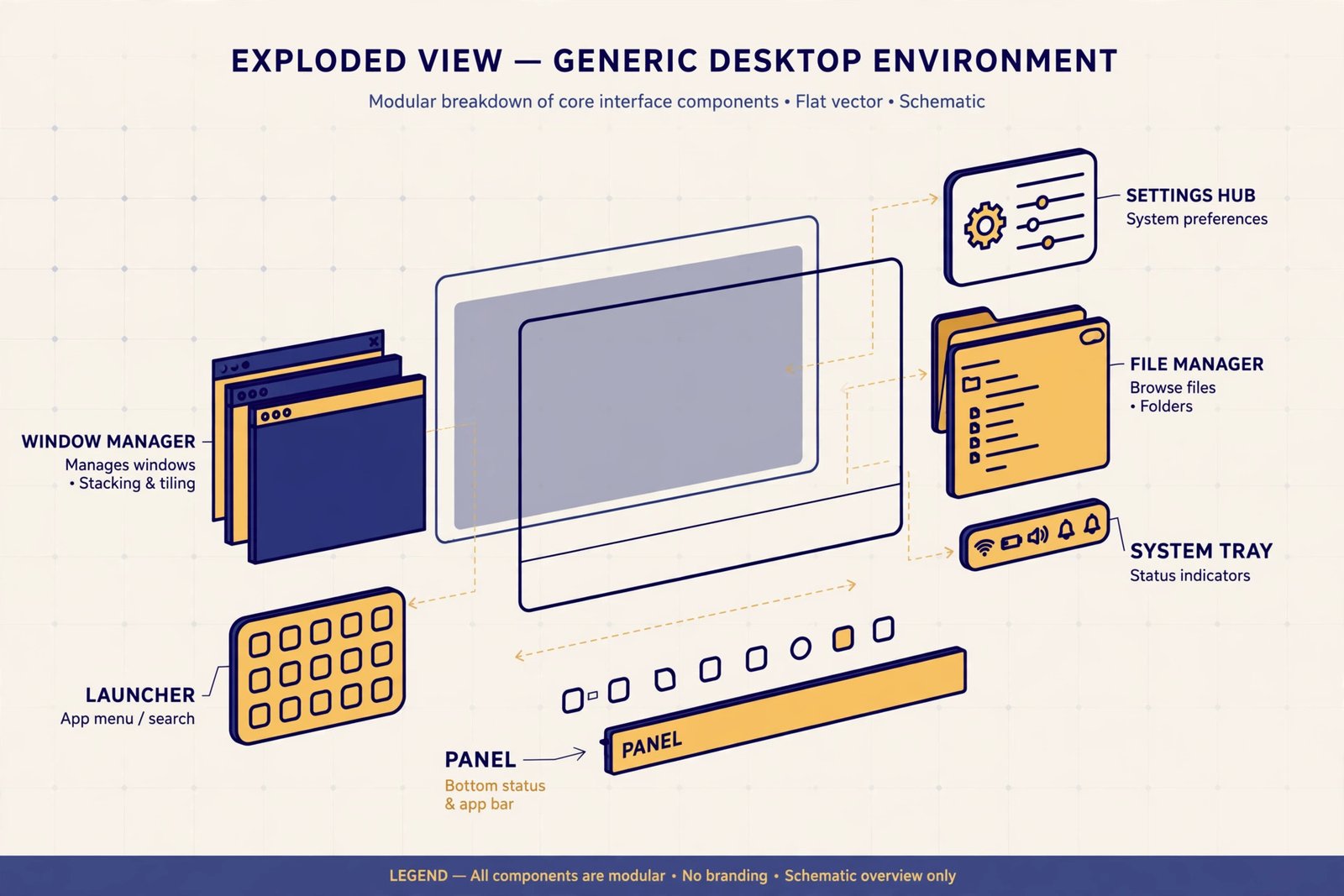
A lot changed on the Linux desktop in 2026. GNOME 51 landed with a rewritten window manager and passkey logins, KDE Plasma matured into its 6.7 release, System76’s COSMIC desktop reached a stable 1.0, and Ubuntu’s 26.04 LTS settled on GNOME 50 while Fedora 45 pushes GNOME 51. If you are choosing a desktop environment this year, you are not picking from the same lineup as 2024. Here is a guided tour of the six that matter, answering one question for each: what is actually here, and why should you care.
How to try any of these in an afternoon
The tour below is the article, but you only need three steps to see any desktop for yourself:
- Step 1. Grab a distro ISO that ships the desktop you are curious about: Fedora 45 Workstation for GNOME 51, the Fedora KDE spin for Plasma 6.7, Pop!_OS 24.04 LTS for COSMIC 1.0, or Linux Mint 22.3 for Cinnamon 6.6.
- Step 2. Write it to a USB stick with a tool like balenaEtcher.
- Step 3. Boot the stick and choose the “Try” or “Live” option. You get the full desktop without installing anything.
Now the tour. Each desktop below gets the same treatment: what you will find inside it, and who it is actually for. The honest trade-offs are included, because every one of these has one.

What’s inside each desktop environment
1. GNOME 51: the desktop that gets out of your way
Open GNOME and you see almost nothing: a top bar, a dock that hides itself, and the Activities overview where you search for apps and swipe between workspaces. Inside, GNOME 51 brings a new Bazaar app store built for Flatpak, passkey logins, and a rewritten Mutter window manager that makes everything feel smoother. The philosophy is “just give me a consistent workflow,” and it executes that better than anyone.
Why you should care: If you want the desktop to disappear so the work can start, this is it. It is the default on Ubuntu and Fedora for a reason, and it has the best laptop and touchpad experience on Linux. The trade-off: customization is limited unless you install extensions, and extensions can break when GNOME updates.
2. KDE Plasma 6.7: the desktop that lets you change everything
Plasma is the mirror image of GNOME: panels anywhere, widgets everywhere, and a settings app with hundreds of options. Version 6.7 runs on both Wayland and X11, and its multi-monitor control is the best on Linux, which matters if you dock a laptop. Despite the reputation, it idles lighter than GNOME on most distros.
Why you should care: If your reaction to a new desktop is “how do I make it mine,” Plasma is home. Windows converts feel instantly at home, and tinkerers never run out of things to adjust. The trade-off: the sheer number of options can overwhelm newcomers, and theming is occasionally inconsistent between apps.
3. COSMIC 1.0: the keyboard-first desktop for people who build things
System76’s COSMIC reached stable 1.0 in 2026 and ships on Pop!_OS 24.04 LTS. It is written in Rust, it is Wayland-native, and automatic window tiling is built in from the start rather than bolted on. Workspaces, a launcher you can drive entirely from the keyboard, and a clean aesthetic round it out.
Why you should care: Developers who live in the keyboard will feel productive in an hour. It is fast, focused, and secure by design. The trade-off: the ecosystem is young: fewer third-party integrations and less community documentation than GNOME or Plasma.
4. Cinnamon 6.6: the familiar desktop for Windows switchers
Cinnamon is Linux Mint’s house desktop: a classic bottom panel, a start-style menu, and applets for weather, workspaces, and system controls. Version 6.6 keeps the traditional layout polished and predictable. Nothing here will surprise you, and for millions of switchers that is exactly the appeal.
Why you should care: If someone is moving from Windows and is nervous about Linux, Cinnamon is the gentlest landing. It is stable, well-documented, and the Mint community is famously patient. The trade-off: benchmarks show it uses noticeably more battery than GNOME or Plasma on laptops, and its Wayland support is still partial.

5. Xfce: the lightweight that refuses to break
Xfce looks like 2010 and idles at a fraction of the memory of the desktops above, which is precisely its job. It is modular, rock-stable, and still X11-first while its Wayland work progresses. On old laptops and servers it is often the difference between a usable machine and e-waste.
Why you should care: Old hardware, virtual machines, remote desktops: Xfce keeps them snappy when everything else feels heavy. Its philosophy is “keep it simple and don’t break what works.” The trade-off: the default look is dated without theming, and full Wayland support is still on the way.
6. MATE: the classic, preserved
MATE is the GNOME 2 desktop, lovingly maintained: two panels, a traditional menu, and a conservative update philosophy. It uses slightly more resources than Xfce but feels instantly familiar to anyone who used Linux in the 2000s or 2010s.
Why you should care: For stable, low-change environments, classrooms, and offices that value predictability over novelty, MATE is the quiet professional. The trade-off: development is slow, so new display tech arrives here last.
Quick comparison
| Desktop | Best for | Resource use | Wayland |
|---|---|---|---|
| GNOME 51 | Focused daily work, laptops | Moderate-high | Native, Wayland-only on Fedora |
| KDE Plasma 6.7 | Power users, multi-monitor | Moderate | Yes, plus X11 |
| COSMIC 1.0 | Keyboard-driven developers | Light-moderate | Native only |
| Cinnamon 6.6 | Windows switchers | Moderate | Partial |
| Xfce | Old hardware, servers | Very light | In progress, X11 for now |
| MATE | Stable, predictable setups | Light | Partial |
The real decision: three philosophies
Strip away the version numbers and you are choosing between three ideas. KDE says “let me control everything.” GNOME says “just give me a consistent workflow.” Xfce says “keep it simple and don’t break what works.” COSMIC, Cinnamon, and MATE are variations on those themes. Pick the philosophy you can live with every morning, because the technically newest desktop is not automatically the best one for you.
Also read
- Best Linux distros for beginners: which distro to pair with the desktop you just picked.
- Best lightweight OS for an old laptop: when Xfce or LXQt is only half the answer.
- Best Linux distro for an old laptop: distro-level picks for reviving aging hardware.

- How to Change the Screenshot Save Location on Mac - October 24, 2026
- How to Turn Off Stage Manager on Mac - October 23, 2026
- How to Reset Your Private Space PIN on Android If You Forgot It - October 22, 2026