An NFT rug pull happens when a project creator disappears with investor money or abandons the project entirely. Your digital assets become worthless, and your investment vanishes. This isn’t rare. Thousands of people lose money to rug pulls every year in the NFT space.
The good news? You can avoid most rug pulls by learning what to look for before you buy. This guide shows you exactly how.
What Is an NFT Rug Pull and Why It Matters
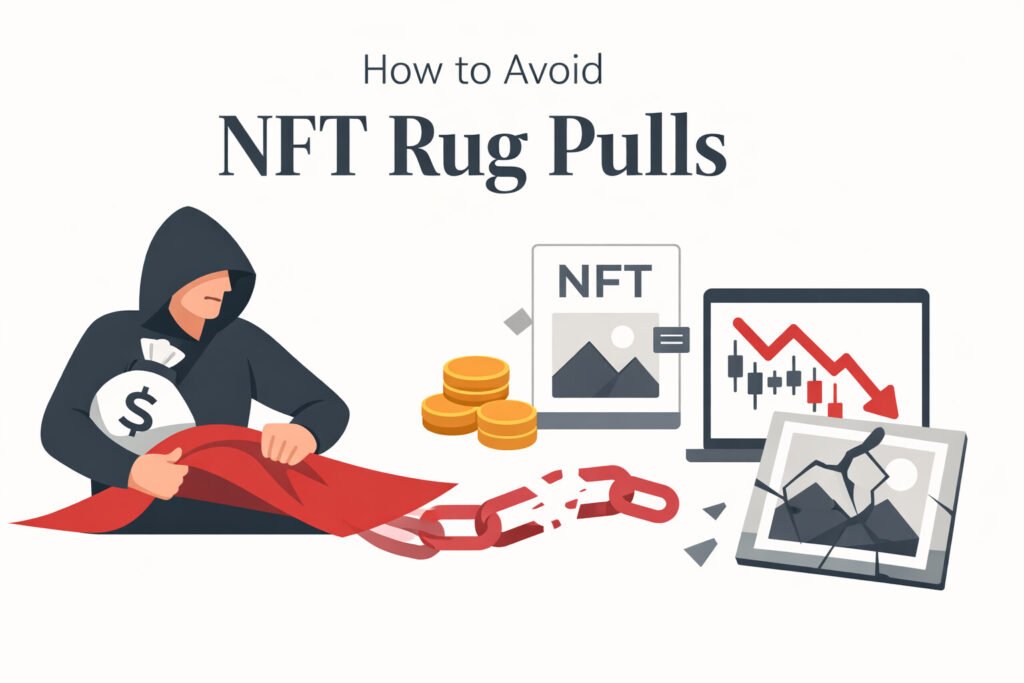
A rug pull is fraud. The creators launch an NFT project, collect money from buyers, then disappear or stop development. The term comes from the phrase “pulling the rug out from under someone.” Investors are left holding worthless NFTs.
Common rug pull tactics include:
- Creators take all funds and vanish
- Developers promise features that never arrive
- Teams gradually reduce communication
- Liquidity gets removed from trading pools
- Whitelist spots are sold to insiders only
- Smart contracts contain hidden drain functions
Why This Matters to You
NFT projects operate in a less regulated space than traditional investments. There’s no SEC oversight in most cases. You can’t rely on official protection. You must protect yourself.
The average rug pull costs victims between 10,000 and 100,000 dollars. Some cost millions. Protection requires active due diligence on your part.
Red Flags That Signal a Potential NFT Rug Pull
Team Anonymity and Lack of Verification
Real NFT projects have real people attached to them.
Check if the team is anonymous. Anonymous doesn’t automatically mean fraud, but it removes accountability. Compare this to traditional business. You know who runs the company. You can track them down legally.
Look for verified identities. Search for team members on LinkedIn. Check if they have a history in blockchain or tech. See if their other projects succeeded.
Review social proof. Real team members have portfolios. They’ve worked on other projects. They have reputation to lose.
If a team hides their identity without clear reason, your risk goes up significantly.
Unclear or Unrealistic Use Cases
Many rug pull projects use vague language about what they actually do.
Watch for buzzwords without substance. Phrases like “revolutionary technology” or “blockchain innovation” mean nothing without specifics. Ask yourself: what problem does this actually solve?
Unrealistic promises signal danger. If a project claims 1000% returns guaranteed, it’s not real. No investment guarantees those returns. If it sounds too good, it is.
Vague roadmaps are suspicious. Real projects have detailed timelines. They specify what gets built and when. Vague roadmaps like “build community Q1” and “develop features Q2” show no actual plan.
Real projects can explain their use case in simple terms. You should understand it in under 2 minutes.
Excessive Hype and Pressure to Buy Now
Legitimate projects don’t rush you.
Pressure tactics mean trouble. Creators saying “limited spots” or “price increases tomorrow” want you to skip due diligence. Slow down when you see urgency.
Influencer backing without substance. Some rug pulls pay influencers to promote before anyone can verify the project. Real partnerships involve established influencers with reputation to protect.
Community excitement that feels forced. Read Discord messages. Do people genuinely discuss features? Or do they just hype the price? Real communities debate the roadmap. Fake ones only talk about getting rich.
Watch for communities where anyone questioning the project gets banned. That’s a major warning sign.
Limited Project History
Check how long the team has been working together.
New accounts are riskier. Social media accounts created days before the launch show planning fraud, not planning a business.
Previous projects matter. Search for what team members built before. Did past projects succeed or fail? Can you find community feedback about their work?
Communication history tells stories. Review Discord or Twitter going back months. Did developers engage with community questions? Or did they remain silent until launch?
Real teams build in public for months or years before major launches. This takes time and commitment. Rug pull teams move fast.
Suspicious Smart Contract Code
This gets technical, but you don’t need to be a programmer to spot problems.
Check the contract on blockchain explorers. Use Etherscan or Solscan depending on the blockchain. Look at the code.
Red flags in the code:
- Owner can mint unlimited tokens
- Owner can pause trading
- Ownership isn’t renounced
- Hidden fees that benefit creators
- Functions that drain liquidity
Verify the contract wasn’t recently modified. Changes right before launch look suspicious. Check the transaction history.
Use contract audit sites. Services like CertiK or OpenZeppelin verify code safety. Look for audit badges, but don’t trust them completely. Some audits are fake.
If you don’t understand the code, ask in communities like r/web3 or specialized Discord servers. Real community members will help explain it.
Suspicious Tokenomics
Tokenomics describes how tokens are distributed and used.
Founder allocations matter most. If creators own 50% of tokens, they can dump on you. Check what percentage the team holds. Anything over 20% for the team is suspicious.
Vesting schedules are important. This locks tokens so creators can’t sell immediately. Real projects have vesting periods of 1-2 years or more. Projects with no vesting let founders cash out right away.
Check if liquidity is locked. Liquidity should be locked on a platform like Uniswap or Raydium for a set period. Locked liquidity prevents creators from removing funds.
Total supply matters. Some projects hide that they can mint infinite tokens. Check if there’s a hard cap. If supply is unlimited, the token has no scarcity value.
Use websites like Rugscreen or Token Sniffer to analyze tokenomics automatically. These tools flag suspicious distributions.
How to Research an NFT Project Before Investing
Step 1: Verify the Official Website and Social Media
Check the URL carefully. Scammers create fake websites with similar names. “Opensea.io” versus “opensea-official.io” look similar but are different. Bookmark the real site.
Review social media accounts. Look at Twitter or Discord creation dates. Real projects have accounts from months ago. Verify the account badges on social media.
Look for consistent information. Does the website match the Discord? Do social accounts link to the same website? Inconsistencies suggest fraud.
Cross-check links. Click every link from the official website. Do they go to legitimate sites? Do the pages exist?
Take 10 minutes here. This prevents 90% of scams.
Step 2: Join and Analyze the Community
Read the Discord without buying. Spend a few days observing. Don’t participate yet.
Watch for moderator behavior. Real moderators answer questions. Fake moderators ban people who ask tough questions. See if critics get silenced.
Look at message velocity. Count messages per hour. Fake communities buy members and use bots. Real communities have genuine conversation.
Check member quality. Read individual messages. Are people discussing actual features? Do they understand what they’re buying? Or are they only focused on price?
Ask specific questions. Ask about the team background or technical implementation. See how they respond. Do they give detailed answers or avoid specifics?
Real communities welcome questions. Suspicious communities shut down skepticism.
Step 3: Investigate the Team Members Individually
Google each team member’s name. Include variations and misspellings.
Check LinkedIn directly. See if they claim experience in this space. Verify previous employment matches their story.
Look for their past projects. Search for GitHub accounts. Check if they contribute to open-source. See if other projects cite them.
Review Twitter history. How long have they been in crypto? Do they have consistent presence? Or did they suddenly appear for this project?
Find interviews or podcasts. Real team members do interviews about past work. This creates a searchable record.
Contact previous colleagues. If someone claims they worked together, reach out and verify.
This takes time. Real teams will have verifiable histories. Fake teams won’t.
Step 4: Examine the Whitepaper and Documentation
Read it completely. A real whitepaper is 10-30 pages. It explains the technical implementation.
Check for specific details. Does it explain how the technology works? Can you understand the mechanism? Or is it full of buzzwords?
Look for realistic timelines. Real projects have detailed roadmaps with specific dates and deliverables. Vague timelines are suspicious.
Verify claims with sources. Does the whitepaper cite other research? Can you verify the citations?
Check for plagiarism. Copy sections into Google. See if they appear in other projects. Plagiarized whitepapers signal low effort.
Look for author information. Who wrote this? Can you verify they’re real? Do they have credentials?
A legitimate whitepaper shows serious work. It’s boring. It’s detailed. It’s specific.
Step 5: Review Financial and Legal Information
Check for business registration. Real companies register with governments. Look up the company name on business databases.
Review the terms of service. Does it have clear terms? Or vague language that avoids responsibility?
Look for legal disclaimers. Real projects have disclaimers about risk. They acknowledge they’re not regulated like securities.
Check if they’re registered with regulators. Some projects register with the SEC or similar bodies. Real registration is verifiable.
Look for insurance or audits. Some legitimate projects purchase insurance against hacks. They get audited by recognized firms.
Review financial backing. Who invested money to start this? Are they known investors? Can you verify the funding?
Legitimate projects have legal structure. They take responsibility seriously.
Tools and Platforms That Help You Verify NFT Projects
Contract Analysis Tools
Etherscan and Solscan
These are blockchain explorers. They show you the actual code behind smart contracts.
How to use them: Paste the contract address into the search bar. Look at the “Code” tab. Search for warning signs like “selfdestruct” or admin functions that drain funds. Read the contract line by line if you can. If you can’t, ask someone who can.
Token Sniffer
This platform analyzes smart contracts automatically and flags risks.
How to use it: Enter the contract address. The tool scans for hidden functions, ownership issues, and suspicious code patterns. Pay attention to its risk rating, but don’t rely solely on it.
Rugscreen
Rugscreen analyzes tokenomics and contract safety for multiple blockchains.
How to use it: Enter the token address. Review the report carefully. It shows you the ownership distribution, vesting schedules, and code issues. Focus on the owner balance and mint function.
These tools aren’t perfect, but they catch obvious fraud quickly.
Community Verification Platforms
Dewu Labs and similar verification services
Some communities offer verified project status after review.
What to look for: Verified badges from trusted sources matter. But don’t assume verification means the project is completely safe. Verification checks past performance, not future results.
Recognized NFT communities
Communities like Bankless DAO and real NFT Discord servers have reputation to protect. They sometimes vet projects.
How to use them: Join established communities. See what projects they discuss and recommend. These communities do homework you might miss.
Market Analysis Sites
CoinMarketCap and CoinGecko
These track NFT and token prices and provide information about projects.
What they show: Trading volume, price history, holder distribution, and community discussions. Look at historical price graphs. Did the price gradually increase? Or did it spike then crash (a rug pull pattern)?
OpenSea and other marketplaces
The actual NFT marketplace data tells stories.
What to look for: How many transactions are happening? What’s the price trend? Are there many sellers or just the creator selling? High creator sales with no other activity is suspicious.
Smart Investment Practices to Minimize Risk
Only Invest Money You Can Lose
This is the fundamental rule. NFTs are speculative. A project can fail for reasons outside anyone’s control. Plan for total loss.
Set your budget before researching. Decide how much you’re willing to lose. Then stick to that number. Emotional decisions lead to bigger losses.
Never invest borrowed money. Credit cards, loans, margin trading. These amplify losses. If you lose, you still owe the money.
Diversify Your NFT Portfolio
Don’t put everything in one project. If you’re investing 10,000 dollars, don’t put it all in one NFT collection.
Spread across different projects. Invest smaller amounts in 5-10 projects instead of 1-2. If one is a rug pull, you lose less.
Mix established and new projects. Established projects are lower risk. Newer projects offer higher upside. Balance both.
Consider different blockchains. Ethereum, Solana, and Polygon each have different risk profiles and project quality.
Diversification doesn’t guarantee profit. But it limits catastrophic loss.
Start Small with New Projects
Your first investment in a new project should be small. Maybe 100 to 500 dollars.
Observe before increasing investment. Watch the project for weeks or months. Does the team deliver? Does the community grow genuinely?
Increase only after milestones. If the team delivers on roadmap promises, invest more. If they miss deadlines without explanation, reduce your position.
Exit if red flags appear. If the team goes silent or community sentiment shifts, sell and move on. Don’t hope it recovers.
This approach lets you learn without losing everything.
Keep Records of Everything
Document your research. Screenshot the whitepaper, team information, and your findings.
Track all transactions. Record when you buy, the price, and the contract address.
Monitor the project monthly. Check if the team is still active. Are they delivering on promises?
Update your risk assessment. As the project evolves, your assessment changes. Update it.
Save communication. If you have conversations with the team, keep them. They become evidence if fraud occurs.
Good records help you learn from mistakes. They also help in any legal dispute.
What to Do If You’ve Been Rug Pulled
Immediate Actions
Stop buying immediately. Don’t throw good money after bad. Accept the loss and move on.
Document everything. Screenshot the Discord, Twitter announcements, and website. Save anything showing what happened.
Report to the blockchain. Report the address to Etherscan. Report to the marketplace where you bought.
Contact law enforcement. File a report with your country’s fraud bureau. Include all documentation.
Recovery Attempts
Some NFTs can be traced. If creators moved funds to exchanges, there’s a chance law enforcement can recover them. This is rare but possible.
Class action lawsuits. If many people were defrauded, a lawsuit might recover some funds. Look for lawsuits others have started.
Blockchain analysis firms. Some firms specialize in tracing stolen cryptocurrency. They’re expensive but sometimes successful.
Learning and Moving Forward
Analyze what you missed. Look back at your research. What red flags did you ignore? What would you check next time?
Share your story. Help others avoid the same mistake. Post your findings in communities. This protects others.
Don’t seek revenge. Some people try to hack the scammer back or find them personally. This is illegal and dangerous.
Move on and rebuild. Accept the loss as education. Use that knowledge for better decisions.
Key Differences Between Safe and Risky NFT Projects
| Aspect | Safe Projects | Risky Projects |
|---|---|---|
| Team Identity | Verified, verifiable | Anonymous, untrackable |
| Whitepaper | Detailed, specific | Vague, buzzword-heavy |
| Community | Questions welcomed | Critics banned |
| Development | Regular updates, delivered | Silent, missed deadlines |
| Tokenomics | Clear distribution, locked liquidity | Founder-heavy, unlocked |
| Social Media | Months old, consistent | New, inconsistent |
| Price Growth | Gradual, organic | Sudden spike then crash |
| Roadmap | Specific dates and deliverables | General timelines |
| Audits | Third-party verification | Self-audited or none |
| Previous Projects | Successful history | No history or failures |
Summary
Avoiding NFT rug pulls requires active investigation. You must verify teams, analyze code, join communities, and research thoroughly. There’s no shortcut.
The process takes time. Spend at least a week researching before investing. This effort pays off by preventing loss.
Remember: if something feels rushed or pressured, slow down. Real opportunities don’t disappear. Fake ones do.
The best protection is skepticism. Question everything. Look for verifiable proof. Accept that you might be wrong.
When in doubt, don’t invest. There will always be another opportunity. But once you lose money to a rug pull, you can’t get it back.
Use these strategies consistently. They dramatically reduce your risk. They won’t eliminate it completely. But they move you from victim to investor making informed decisions.
Start small. Research thoroughly. Diversify widely. Track everything. Learn constantly.
Follow this approach and you’ll avoid most rug pulls. You’ll make better investments. You’ll build wealth instead of losing it.
Frequently Asked Questions
How can I tell if a project is definitely safe?
No project is definitely safe. All investments carry risk. Even established projects can fail or get hacked. What you can do is identify lower-risk projects. Look for verified teams, detailed documentation, transparent tokenomics, and community engagement. Even then, assume you might lose everything.
Are anonymous teams always bad?
Not always. Some legitimate projects stay anonymous for privacy or safety. But anonymous projects carry higher risk because they lack accountability. Ask yourself: would I invest in a traditional company with anonymous leadership? If not, why invest in crypto with anonymity? Anonymous should mean extra scrutiny, not automatic rejection.
How long should I research before investing?
Minimum one week. For larger investments, take 2-4 weeks. Real projects aren’t going anywhere. Rug pulls disappear if you wait. Use this time to verify the team, read documentation, monitor the community, and analyze the smart contract. Take notes on what you find. Let information settle before deciding.
Can I recover money from a rug pull?
Sometimes, but rarely. Law enforcement and blockchain analysis firms can occasionally trace stolen funds. If enough people were defrauded, a class action lawsuit might recover partial funds. For most people, the money is gone. Focus on preventing it rather than recovering from it.
Should I invest in established blockchains or emerging ones?
Start with established blockchains like Ethereum for lower risk. As you learn, you can explore Solana, Polygon, and others. Each blockchain has different security levels and community quality. Ethereum has the most scrutiny. Newer blockchains have more experimental projects with higher risk and higher potential rewards.